Labour / Le Travail
Issue 94 (2024)
Article
“Thoroughly Impregnated with Bolshevik Philosophy”: Annie Buller’s Incarceration and Canadian Political Policing during World War II
Abstract: Annie Buller makes for an interesting case study of Canada’s World War II security state and how it functioned vis-à-vis the Communist Party of Canada and its allies. Her experiences speak to gender, party history, and broader elements of political policing, community responses, and confinement experiences. Like her life, her wartime encounters with the Canadian security state were concurrently like and different from those of other criminalized female and male activists at the time about whom we know more. Among the apprehended and incarcerated, female or male, Buller was somewhat of an anomaly and warrants special attention. Buller’s particular situation helps to shed light on lesser-understood elements of the Communist wartime carceral experience, including the lack of trust officials had in these processes at times to accomplish the intended repression and important details about efforts to free those incarcerated. Ultimately, Buller’s case and the movement to liberate her and the other incarcerated members of the party illustrate the power of grassroots activism in challenging oppressive systems.
Keywords: Annie Buller; Communist Party of Canada; political policing; internment; National Council for Democratic Rights
Résumé : Annie Buller constitue une étude de cas intéressante sur l’État sécuritaire du Canada pendant la Seconde Guerre mondiale et sur la manière dont il a fonctionné vis-à-vis du Parti communiste du Canada et de ses alliés. Ses expériences parlent du genre, de l’histoire des partis et d’éléments plus larges de la police politique, des réponses communautaires et des expériences de confinement. Tout comme sa vie, ses rencontres en temps de guerre avec l’État sécuritaire canadien étaient à la fois semblables et différentes de celles d’autres activistes, hommes et femmes, criminalisés à l’époque, sur lesquels nous en savons davantage. Parmi les personnes appréhendées et incarcérées, hommes ou femmes, Buller constituait en quelque sorte une anomalie et méritait une attention particulière. La situation particulière de Buller contribue à mettre en lumière des éléments moins bien compris de l’expérience carcérale communiste en temps de guerre, notamment le manque de confiance des responsables dans ces processus pour accomplir la répression prévue et des détails importants sur les efforts visant à libérer les personnes incarcérées. En fin de compte, le cas de Buller et le mouvement visant à la libérer ainsi que les autres membres incarcérés du parti illustrent le pouvoir de l’activisme populaire pour contester les systèmes oppressifs.
Mots clefs : Annie Buller; Parti communiste du Canada; contrôle politique; incarcération; National Council for Democratic Rights
In March of 1940, 44-year-old Annie Buller became a wanted woman following a raid on the Winnipeg offices of the Mid-West Clarion. This newspaper, an official Communist Party of Canada (cpc) publication, had been banned under the Defence of Canada Regulations (docr) the previous November.1 The police failed to apprehend Buller, who was the paper’s business manager, and she successfully evaded capture for almost a full year. By the time she was arrested in February 1941, she faced numerous charges both in connection with the newspaper and also as a leading member of the cpc, which had been outlawed in June 1940. Her encounter with political policing and the Canadian justice system led to her trial and conviction and a two-year prison sentence, as well as plans to include her among the more than 100 leftists already interned under the docr.2
Annie Buller is a fascinating cpc figure and a bit of an anomaly – unusual and not. In some respects, her life was conventional. She was married, a mother with a son, a situation she often referenced. All this fit with the heteronormative family structure and prescribed feminine gender expectations typical of the party’s Popular Front efforts in the mid to late 1930s and certainly of wider Canadian society.3 But Buller, as Joan Sangster notes, “had the difficult task of balancing motherhood with an intense, transient political life.”4 This is because she practised her activism in ways unusual for a woman. She was an imposing leader, nationally prominent, and an unapologetic firebrand, with a demonstrated track record as a dedicated and driven national and grassroots labour organizer. In this capacity, she frequently travelled and organized for stretches away from home and family and was sometimes jailed for this work. These activities flew in the face of gender norms within and without the party, especially for a mother.
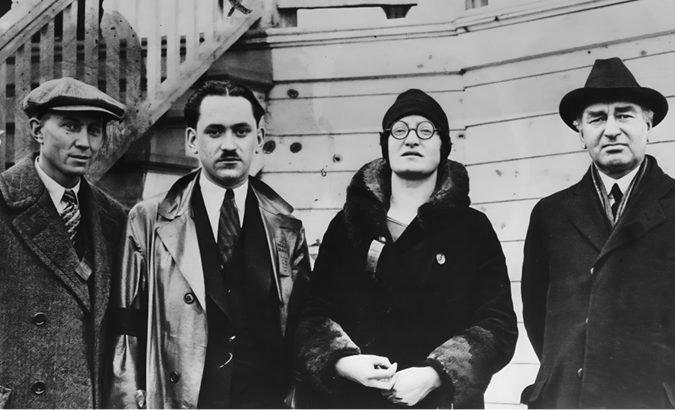
Figure 1. Annie Buller with (left to right) cpc leader Tim Buck, Norman Freed, and A. E. Smith, n.d.
Robert S. Kenny Papers, Ms coll 179, box 63b, Thomas Fisher Rare Book Library, University of Toronto.
Among leftists incarcerated during World War II, Buller makes for an interesting case study. Like her life, her wartime encounters with the Canadian security state were concurrently similar to and different from those of other criminalized female and male activists at the time about whom we know more. Like the eleven other incarcerated women activists and a few of the men, Buller served her time in a jail, convicted in court of crimes under the Defence of Canada Act. In contrast, the majority of the male prisoners, by consequence of being interned without formal charges or trial, usually served their time as a large group in one or two internment facilities (Petawawa, Kananaskis, Hull).5 For a significant portion of her jail time, Buller was alone or with only one or two comrades, like the other women prisoners. But Buller differed from the other women prisoners, too, in that she, as a high-ranking member of the party, was the only woman leader with a national profile who ended up in jail.6 The charges that authorities pinned on her as a result of her leadership role resulted in a much longer sentence than the other women received. As an incarcerated woman and party leader, then, Buller was an anomaly and warrants special attention. Her case reveals much about the extent of the state’s efforts to apprehend and incarcerate a figure such as Buller, the unrepentant way Buller responded to these efforts, and the way activists mobilized pressure to achieve her release.
World War II and Political Incarceration
As part of their nation-building strategy, Canadian authorities, like those in other settler-colonial places, have long deployed a host of carceral strategies in various forms as a means to control, contain, and/or assimilate so-called troublesome communities of racialized persons, political dissenters, and Indigenous peoples who posed direct or indirect threats to the white supremacist liberal capitalist economy and social order. World War II was a particularly intensive period for this sort of carceral containment. Under the guise of safeguarding national security and the successful prosecution of the war effort, the state forced relocation, detention, and internment upon numerous groups. The “evacuation,” internment, and dispersal of over 22,000 Japanese Canadians from the West Coast starting 24 February 1942 is the most well-known, and Japanese Canadians were certainly the most brutally impacted group during the war and beyond.7
Processes of internment, settler colonialism, and the displacement of Indigenous peoples are mutually co-constitutive functions, asserts Mona Oikawa: “This carceral continuum must necessarily draw upon colonial, internment, and other discourses that have historically rendered Indigenous peoples and racialized groups outside of or marginal to the Canadian nation and have been relationally constitutive of the notions of ‘national security’ and ‘freedom.’”8 This continuum also applies to ideological positions that have, at various junctures, been deemed necessary for quarantine from the Canadian body politic.9 The “relationally constitutive” relationship between state security apparatus and the perceived threat posed by Communists such as Buller is suggested by the way her incarceration continued, as we will see, even as the geopolitical circumstances that justified it changed dramatically when Canada became allied with the Soviet Union during World War II.
The cpc and allied leftists were targets of the state from the outset of the war.10 In September 1939, Mackenzie King’s government invoked the War Measures Act and, using this, created the Defence of Canada Regulations. These emergency powers, which “passed the authority of government to the war committee of the federal cabinet,” John English explains, “had enormous influence in limiting free speech, suspending habeas corpus, interning suspicious individuals or groups, and confiscating property.”11 In practice, Sangster notes, this allowed for “detention without trial, trial in closed courts, and stiff sentences for anti-war activity.”12 By design, targets of this repressive legislation had limited legal recourse with which to resist such treatment.
Federal authorities pointed to anti-war activity to justify the persecution of the cpc and its close allies. The cpc’s official opposition to the war followed the Nazi-Soviet non-aggression pact of 1939 and continued until Germany invaded the Soviet Union on 22 June 1941. Yet political expediency may have also played a role: the left had enjoyed a rise in popularity in the latter half of the 1930s. With increasing membership numbers – the cpc counted around 16,000 official adherents; the Ukrainian Labour Farmer Temple Association (ulfta), a fellow traveller, “ethnic hall” socialist organization, had over 15,000 – the cpc also had success in organizing industrial unions and promoting labour militancy in the Depression years. As John Manley explains, the cpc “had greater social, political, moral and cultural force than at any time in its history. If only in a small way, it was capable of influencing the course of national events.”13 And while the party’s stance on the pact and the war had led to a rapid drop in support, government officials – encouraged by the rcmp, other red-baiters, fifth-column hysteria, and public concerns for subversion and sabotage – seized on the wartime opportunity and docr powers to drive what they hoped would be a final nail in the Communist coffin. As Ian Radforth notes, “The government wanted to be seen to respond effectively to widespread public fears that saboteurs within Canada posed a serious threat to the success of the war effort, as well as to public safety.”14
Respond they did, with the eventual apprehension and incarceration of more than 130 cpc and allied leftists, including trade union officials, journalists, and leaders; the banning of numerous party-aligned newspapers, including the cpc’s Mid-West Clarion, where Buller worked; and the outlawing of the cpc and many connected or adjacent organizations, like the ulfta, the Finnish Organization of Canada (foc), and the Canadian Labour Defense League (cldl), among others. Many of the ulfta’s properties were confiscated and, in some cases, sold to rival nationalist Ukrainian groups.
Historians of the Canadian left have documented various elements of this history; in some ways, it is a well-worn topic. Scholars have tackled the broad impact of the state’s attack on the left during the war, the day-to-day life of men in internment facilities, and experiences of particular party or party-aligned communities or internees.15 A handful of former male internees, their relatives, and supporters have published richly recounted memoirs.16 Women prisoners, too – including Gladys MacDonald, the sole Communist woman internee – have been the subject of some research.17 Some general histories of the cpc and its affiliates include commentary on political policing during World War II and the internments.18 Histories of state security have highlighted the episode.19 Taken together, this body of literature documents many aspects of the state’s wartime efforts to eliminate the alleged Communist threat both to the war effort and to Canadian capitalist state hegemony. Focusing on Buller, this article, then, joins the efforts of others endeavouring to better expose the work and significance of women cpc activists in the context of the World War II security state.
Consideration of Buller’s unique circumstances adds to our understanding of this history in several ways. Buller’s experience offers an example of what life was like for those activists who managed to go underground and avoid arrest, at least for a time. It exposes key wartime political policing methods, which shifted from simply surveilling parties of interest to singling out individuals for apprehension; if these individuals were on the lam, this work extended to tracking, monitoring, and when the timing was right, attempting to capture them and others of note with whom they were associating. Buller’s story also reveals the ways the rcmp and other authorities used the docr’s powers to circumvent established legal traditions, court processes, and basic civil liberties to silence activists by issuing internment orders on those slated for trial, ensuring that no matter a court’s decision, the activists would end up incarcerated.
Buller’s case also reveals significant elements of community resistance. Freeing Buller was a focus of the little-studied National Council for Democratic Rights (ncdr), which by mid-1941 would replace the banned cldl to become the leading organization challenging the Defence of Canada Regulations as they impacted cpc leftists.
Finally, Buller’s status as a prominent national woman leader makes consideration of her case a significant addition to recent work on criminalized women’s place in the history of the left in this era. The material culture that Buller produced behind bars helps document the underexplored carceral experience of those, both women and men, who served their time in jail mostly in isolation from all but perhaps one or two comrades. This contrasts with the well-documented experiences of those groups of male prisoners dispatched to internment facilities, whose collective experience has been centred in the historiography.
To tell the story of Buller’s wartime incarceration, this article draws upon a variety of sources, many newly unearthed, including rcmp surveillance files, oral histories, newspapers, biographies, arrest records, correspondence, legal records, and scrapbooks, notebooks, and other materials that Buller and her comrades created and preserved during her time behind bars. Examining Buller’s encounter with political policing processes reveals much about how state security targeted leftists during World War II, how resistance was mobilized in their defence, and how women endured incarceration and emerged, at least in Buller’s case, unbowed and unrepentant.
The Notorious Annie Buller’s Life on the Lam
Prior to her wartime arrest, Annie Buller had enjoyed a long and storied activist history. Born to Jewish parents in Chernivitsi, Ukraine, on 9 December 1896, she migrated with her family to Montréal in the early 1900s. Personal experience and early exposure to socialist ideas fuelled her radicalization. Growing up in a Yiddish-speaking working-class household – her father was a carpenter – young Buller was forced to leave school in 1910, at the age of fourteen, to take up waged work to augment her family’s income. She held a series of jobs, spending three years as a tobacco factory worker before becoming a clerk in a discount store. She then took a sales position at Almy’s department store. She moved up quickly; in the glassware and china department, she was eventually made head buyer, the first woman in Canada to receive such an appointment.
Buller’s engagement with the burgeoning socialist movement in Canada began at the same time. She and her dear friend Becky Buhay became involved in socialist youth movement activities and independent study evenings and weekends. In 1919, Buller left her job at Almy’s to move to New York City to study at the Rand School of Social Science (1906–1956), “one of the most important schools for workers and socialists in modern American history.”20 Shortly thereafter, she returned to Montréal, where, along with another friend, Bella Hall Gauld, and Buhay, she helped found the Montréal Labour College. As historian Anne Toews notes, Buller’s close friendships, but especially her friendship with Buhay, helped drive and sustain her activism. By 1922, Buller had joined the Workers’ Party of Canada, the predecessor to the cpc.21
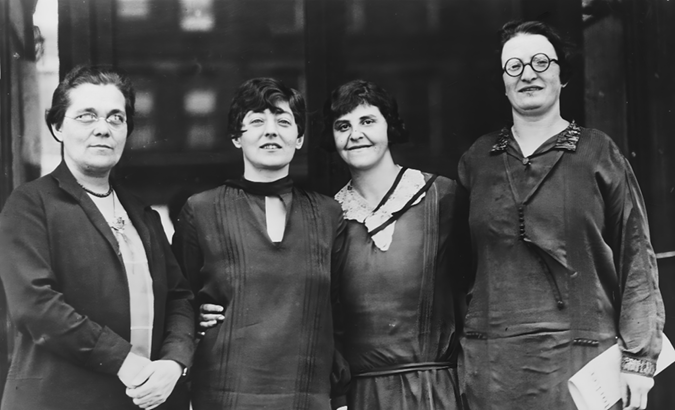
Figure 2. (Left to right) Florence Custance, Emily Lawrence, Becky Buhay, and Annie Buller as delegates at the 1927 CPC convention.
Robert S. Kenny Papers, Ms coll 179, box 63b, Thomas Fisher Rare Book Library, University of Toronto.
On 9 November 1924, Buller married Harry Guralnick, a Jewish left activist and cpc functionary.22 In the interwar years, Guralnick held posts on the party executive and that of its affiliate the cldl, and he was manager of the progressive Jewish newspaper Der Kamf, later renamed Der Veg.23 He later became education director of the United Jewish People’s Order. The birth of their son, Jimmy, soon after did little to curtail Buller’s activism; party work had by then become her full-time occupation. At the time, she was organizing dressmakers in Toronto. She also travelled frequently on national tours and relocated for other work for the party, an unusual role for a mother of a young child to hold then. The family was often separated for months on end as Harry and she carried out their respective activism. Buller was no stranger to state repression of the cpc; she spent a year in jail for her role in supporting striking coal miners in Estevan, Saskatchewan, in 1931. Police charged her with inciting a riot on 29 September, the day that rcmp and local police, at the request of the town’s mayor, violently crushed a peaceful strikers’ demonstration, killing three men.24
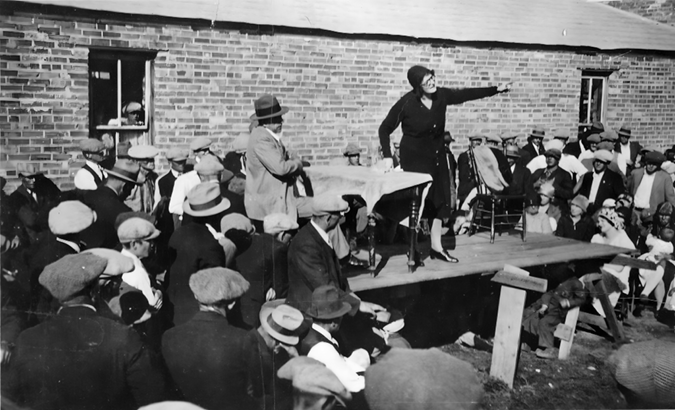
Figure 3. Annie Buller addressing a Sunday meeting at Bienfait, Saskatchewan, on 27 September 1931, during the Estevan coal miners’ strike.
R-A32584, Provincial Archives of Saskatchewan.
This did not dampen – and, in fact, likely helped fuel – her working-class commitment. During the 1930s, despite ongoing state surveillance and the ever-present threat of arrest, Buller managed and wrote for various party publications, playing an important role in union activities. She helped to organize mine workers in the Maritimes and needle trades workers in Toronto.
Buller continued her activism into World War II. Although the cpc was declared illegal, and she was a wanted woman from the spring of 1940 onward, she nonetheless persisted, carrying out her activism covertly, moving frequently and carefully to avoid detection and apprehension. She was not alone in this. In the fall of 1939, anticipating trouble in the wake of the advent of the docr, Canada’s declaration of war, and the cpc’s contrary position on the conflict, the party closed its head office in Toronto and moved its work underground. National leaders like Tim Buck and others, though immediately perceived to be at risk across the country, continued their work, distributing mimeographed bulletins, party directives, and other materials. “From hide-outs in every town from Halifax to Vancouver,” rcmp officials editorialized and alleged, Communist leaders persisted in a “desperate attempt to ‘politicize’ unwary Canadians into becoming adherents of Communism and vassals of Stalin.” A May 1941 rcmp security bulletin lamented, “No matter how many whispering campaigns are broken up, or how many scurrilous leaflets are seized and destroyed, fresh propaganda takes their place.”25
Unfortunately, no sources seem to exist that detail Buller’s exact underground whereabouts or day-to-day activities. However, considering the experiences of others can be useful in imagining what this period may have been like for her. Buck, for instance, according to rcmp sources, claimed to have spent his time between Montréal and Toronto, used three aliases, and continued to work full-time for the party.26 Ontario Communist labour organizer and newlywed Bill Walsh left his wife, Anne, at home and went into hiding in November of 1939. He moved by himself into a hayloft atop a barn in Amherstburg, Ontario, and continued his activism from there, wearing disguises when he needed to venture out, meeting up with comrades in remote locations when necessary, and avoiding arrest until New Year’s Day of 1940.27
The situation was similar for those in Winnipeg, where Buller had been working. By early 1940, John Boyd – who had been on staff at the Clarion in Toronto when it shut down in November 1939 – and his wife, Gladys, were dispatched to Winnipeg and positions with the People’s Co-operative Dairy, an organization founded in 1928 by ulfta members in the city’s working-class North End. While the Boyds were not hiding at that point, their living situation partially demonstrates how the cpc continued to operate secretly there. They were put up in a house in South Winnipeg, which, as John recalled, “would be used as one of the headquarters for the Party’s underground work and for illegal drop-off addresses. We shared the house with Margaret [Mills]…, who was one of the underground captains” and a party “courier for the illegal mail that was going on between the leaders that were in hiding.” John and Gladys worked at the Co-op’s office in the North End, something John described as a “make-do job. It was, of course, very foolish for me to be working openly in the Co-op and living in a place that was being used for illegal Party work.” Mills and the couple took care, he noted, to cultivate a banal and respectable household image, “to make it look like nothing was happening…. [T]he postal thing was also very surreptitious, you know, it wasn’t an open thing at all.”28
Peter Krawchuk was similarly careful. The ulfta newspaper editor was a wanted man following a mass raid on ulfta leaders’ homes in Winnipeg’s North End on 6 July 1940. Krawchuk spent the following days hiding out in his brother-in-law’s home (and cellar, if someone came to the door). Later he dwelled secretly across the river in a house in St. Boniface, which became the organizational office for the “directing collective” he formed along with other ulfta fugitives. They ventured out as little as possible for fear of being recognized – and rightfully so. One fateful day, 28 September 1940, Krawchuk and comrade Steve Macievich went to meet a potential publisher for the newspaper the directing collective was attempting to establish. The man was delayed, and Krawchuk and Macievich cast about for a safe space to wait. “What could we do?” Krawchuk recalled, considering that political policing tactics used to apprehend suspects were known to include a reliance on eagle-eyed informants. “We could not wander about the city centre in the light of day because at any minute the police or their informers, of which there was no lack, could recognize us…. I advised going to the movies because I thought that there it would be safer. In the dark no one would recognize us.” This proved wrong. It was there, in the middle of Alfred Hitchcock’s film Foreign Correspondent, that a police officer nabbed both men.29
In terms of Buller’s underground circumstances, after the raid on the Mid-West Clarion offices in March 1940, police attempted to pick up her trail across Alberta and Saskatchewan, where they suspected she was staying in various safe houses to avoid capture.30 Whether Krawchuk or the Boyds crossed her path during these dangerous months is unknown. It is possible, though, given the system of safe houses that seemed to exist in Winnipeg and across Canada. Authorities certainly believed connections endured, at least according to Krawchuk. On his way to the Kananaskis internment camp, he recalled, “the policeman I rode with was a smart cookie. He asked a lot of questions, asked if I knew Annie Buller and others…. He was always pumping me for information.”31
Police, too, seemed to lean heavily on informants to attempt to determine Buller’s whereabouts, travel plans, and the various safehouses she accessed for food and shelter. For example, via informants, they monitored her Toronto-based teenage son, Jimmy Guralnick, in the hopes that he might inadvertently reveal his mother’s location. At the time, fifteen-year-old Jimmy was attending the city’s Harbord Collegiate – a school apparently chock-a-block with children of committed leftists like Buller and Guralnick, according to rcmp officials. “Harbord Collegiate is a stronghold for yclers,”32 reported Constable M. Black in January of 1941, “and has always been considered one of the most radical collegiates in town.” To simply characterize Harbord Collegiate as a magnet for radical students would be inaccurate, since the school’s catchment, which determined the composition of its student body, was shaped by the geographic boundaries of the neighbourhood. This section of the city happened to be home to a substantial population of working-class families with immigrant roots who were receptive, thanks to past and present experiences, to radical ideas. Overlapping with ethnocentrism and stereotypes of politically “dangerous foreigners,” Constable Black concluded, “There is a large proportion of the Jewish element in attendance at this collegiate.”33 Around that time, an rcmp informant obviously close to the family met up with the boy. The encounter elicited the following information: “From a talk with Annie Buller’s son, Jimmie, who lives in Toronto, it is clear that Anne Buller is either in Toronto or frequently visits the city.”34
Young Jimmy was in an unenviable situation. By then, his father, too, was on the lam, skirting a charge of continuing to belong to an illegal organization – the cpc.35 These (possibly traumatic) wartime experiences, and Annie Buller’s overall career as a far-left organizer, ultimately seemed to fuel Jim’s own activism. As his 2012 obituary noted, “Jim was inspired by his mother’s example to become a lifelong Trade Unionist.” After his time at Harbord Collegiate, he went on to Toronto’s Central Technical School, where he studied graphic arts. He held a number of executive positions, including president, for the Toronto Typographical Union Local 91 and served as a delegate to the Toronto and York District Labour Council.36 Bucking convention, as an adult, Jim Buller chose to eschew the last name of his father in favour of that of his mother, who was by far the more prominent and celebrated activist of the couple.37
Ultimately, tailing Jimmy proved fruitless. However, tailing someone else who was politically connected to Buller did pay off. Just over a month later, on 28 February 1941, the police’s persistence and surveillance tactics were rewarded in Winnipeg. Following a tip from a local informant, city police shadowed Louis Vassil all afternoon. Vassil was the business agent for the Communist-led Industrial Union of Needle Trades Workers (iuntw).38 Apparently, police had been told that Vassil was set to connect with Buller, Guralnick, and several others at a private home, “where a meeting would be held to determine how best the Communist Party could assist Vassil in fomenting trouble in the Garment Industry during the present dispute over wages.”39 Vassil had a busy afternoon. Police waited while he and iuntw president Sam Herbst attended a 2:45 p.m. meeting at garment industry representative Al Bricker’s home at 125 Elm Street. At 4:45, Vassil and Herbst took a taxi downtown to Allen’s Café, across the street from the union’s office in the Donalda Building at 310 Donald. A short while later, still surreptitiously followed by police, both men headed to the union office, where they stayed for about an hour before Vassil returned to the restaurant for supper.
At 7:20 p.m., Vassil continued on his way. Suspecting that something might be up, he seemed to be on guard. According to the officers in pursuit, “During this time he stopped at every street corner and glanced around, apparently watching to see if he was being followed, while he walked hurriedly between the blocks.” Vassil eventually hopped a bus to Winnipeg’s North End, alighting at Logan Avenue and McPhillips Street, where again “he then stood on the corner and looked around.”40 From there, he continued a block down McPhillips to Alexander Avenue, finally entering a house at 1222 Alexander. The officers called for backup and, shortly after, observed a car deliver Buller and Guralnick to the residence. The evening marked a reunion for the fugitive couple, who, according to Guralnick, had not seen each other in over a year.41 Any happiness was short-lived, however, as police reinforcements soon arrived. “By this time, we judged that the meeting had been in progress about half an hour, and that all persons intending to be present, would have already arrived,” reported Detective D. Nicholson, then attending the scene.42 Surrounding all possible exits, officers entered the home and disrupted a living room meeting involving Vassil, Buller, Guralnick, and local party activist John (“Jock”) McNeil. Seemingly understanding her own significance, Buller immediately attempted to take the fall. “I suppose it’s me you want,” she said. “I invited these men to have a conference with me this evening, they are all right.”43
The tactics employed to finally locate Buller – and the resources deployed to arrest her, Guralnick, Vassil, and McNeil – illuminate some political policing strategies used during World War II. Cultivating relationships with informants seems to have been especially key. Surveillance and tailing of associates and kin were similarly important. Careful formal and informal questioning of arrested activists, as Krawchuk’s experience suggests, was likewise employed, in the hope that prisoners might give up useful information – intentionally or inadvertently – about comrades still on the loose. Also critical was patience, over time and in critical moments – in this case, waiting long enough outside the meeting house to ensure all attendees were present.
Mounting a Defence: The CLDL and the CRLP
Despite Buller’s effort to clear the men on the spot, the foursome was hauled down to police headquarters and charged with violating the Defence of Canada Regulations for continuing to be members of the by then illegal cpc. Buller also faced numerous other charges, including multiple counts of publishing subversive literature for her role in the production of the Mid-West Clarion in February of 1940.44 Her calm demeanour at the time of her arrest speaks to her past experience with the law.45 Of the four, Buller was clearly a prisoner of note, a dangerous activist, and a prize catch for authorities if bail amounts were any indication. The men’s was set at $10,000 apiece, while Buller’s was $20,000. Despite these seemingly insurmountable sums,46 none remained long behind bars. It took only a few weeks for the necessary money to be raised, and on 17 March, Buller was released on bail.47 The speed with which Buller’s and the men’s bail was posted was remarkable, given that those supporting and defending the labour prisoners were forced to work especially carefully and often from underground, without an official organization to coordinate their efforts.
Labour’s advocate in times of legal peril, the Canadian Labour Defense League, was among those organizations banned under the docr on 6 June 1940. As Jaroslav Petryshyn explains, the cldl had worked in the interwar decades “promoting communist policies, agitating on behalf of the Communist Party of Canada, and defending before the courts over 6,000 individuals – communists and non-communists alike – who had run astray of the law because of their militant activities.”48 Under the leadership of A. E. Smith and Becky Buhay, in the 1930s, especially significant were the cldl’s challenges of the 1931 show trials and political incarcerations of the cpc’s Kingston Eight (released early in 1934, thanks to the cldl) and its successful campaign for the repeal of Section 98 of the Criminal Code, the basis for the criminalization of the Kingston Eight and other labour activists.49 Critical tactics in the cldl arsenal included fundraising, protest letter and postcard campaigns, mass demonstrations, media engagement, and other efforts to secure and illustrate public support for their causes and command government attention.50
Following Prime Minister King’s repeal of Section 98 in 1936, without a major legal issue around which to rally, Petryshyn notes, “the cldl lapsed into dormancy”; come 1938, according to Manley, it “had been effectively supplanted by the genuinely independent Canadian Civil Liberties Union.”51 On 26 November 1939, however, Smith – on his own, since Buhay, like other cpc leaders and functionaries, was in hiding – resurrected the organization to challenge the use of the docr against Canada’s Communist and pro-Communist left and to support those militants caught in the state’s snare. Smith embarked on a speaking tour to parts of Ontario and western Canada in the new year to bolster support, helping to reactivate local cldl branches, fundraise, and establish bondspersons ready to bail out those who might be arrested.52 The 6 June 1940 ban circumscribed this work, marking the end of the cldl, though in name only. The organizational foundation laid by the cldl remained intact, though its visibility was reduced in the months following the ban.
Following mass arrests during the summer of 1940, several of the wives and other kin of interned men soon filled the labour defence void. Chief among them were Jenny Freed, Alice Bilecki, Mary Prokop, and Rose Penner, the wives of Norman Freed, Tony Bilecki, Peter Prokop, and Jacob Penner, respectively. They came together at first informally, in person and via mail, following their husbands’ arrests, to support one another, share information, speak up for their husbands, secure legal counsel, and strategize means to fight for the men’s liberation. By the spring of 1941, constituting themselves under the banner of the Committee for the Release of Labor Prisoners (crlp) and still working under conditions of state siege, they established active committees in Winnipeg and Toronto, drawing on countrywide support. Smith, Buhay, and others joined the crlp cause, and the organization could count on backing on Parliament Hill from Saskatchewan mp Dorise Nielson.53
In March 1941, a crlp delegation of fifteen of the wives, some with children in tow, travelled to Ottawa to demand a meeting with federal elected authorities. While they were initially refused audiences, their continued pressure eventually resulted in meetings with several officials, including Justice Minister Ernest Lapointe and the House of Commons committee tasked with reviewing the docr. Positive coverage of the group’s Ottawa activities in the Toronto Star assisted their cause. By this point, their agenda had expanded to push for better conditions in the internment camps, visits (which were prohibited for many months), political prisoner status for cpc and party-allied left internees (and the rights that came with that status), and better state-provided financial support for the prisoners’ families. They also called for “the repeal of the obnoxious and anti-democratic Section 21” of the docr, which allowed for the internees’ arbitrary detention without charge, and, of course, the immediate release of all detained cpc prisoners. They compiled a report on their trip, a copy of the brief they had delivered to Lapointe and Prime Minister King, biographies of several interned men, accounts of wives’ struggles to support themselves and their children in their husbands’ absence, and other related materials in the booklet They Fought for Labor – Now Interned!, which sold for five cents to support the crlp’s work.54
It was in this context that the bail for Buller et al. managed to be raised – and it was apparently a particular point of pride for at least one of those involved. An rcmp informant alleged that when speaking of Buller and the men to “a comrade,” “AE Smith gloated over the fact that such a large bail had been successfully raised.”55 This pride was not unwarranted. To amass such an enormous sum in good times for a cause reliant largely on working-class communities would be noteworthy; to do so given the circumstances of illegality and wartime persecution under which the Communist left functioned at this point in the war was perhaps more significant. Inspector A. W. Schultz of the rcmp concurred, noting, “If the information reported above is correct, it is indeed surprising that such a large sum of money could be raised for this purpose at the present time.”56
Trial, Conviction, and Internment as Insurance
Any optimism the raised bail generated was short-lived, however. Just over three months later, on 20 May 1941, an unapologetic Buller appeared in police court and was quickly convicted on two counts related to publishing and printing subversive material. Establishing guilt on a third charge – belonging to an illegal organization – was, oddly, given Buller’s very public political life, more challenging for Crown prosecutor A. A. Moffat. “Annie was a well-known leader in the Party,” her lawyer, Joe Zuken, later noted in an oral history; however, “the Crown had a devil of a time trying to prove membership in the Party. Which was strange because Annie had been up and down this country speaking, making her views known.” Finally, presiding magistrate R. B. Graham, in the interests of moving things along, interrupted Moffat’s cross-examination of Buller. As Zuken recalled,
Magistrate Graham, who was pretty perceptive in some ways, said, “Now I think we’re wasting a lot of time here. I think I know the kind of person Miss Buller is. Now Miss Buller, I’m going to ask you this, are you a member of the Communist Party now?” I said, your honour, my client is prepared to answer that question if you will give her the opportunity to make a statement to the court. He said, “Yes, I will.” And she said, I’m proud to be a member of the Communist Party, and she let loose for about ten minutes with a lesson on political economic history and Marxism and why she was a member of the Communist Party.57
According to the Winnipeg Free Press, Buller’s statement included the following: “Your worship, it is my privilege to be a member of the Communist party, which has defended the best interests of the working people today. It may be illegal or otherwise, but it is a party that is going to lead the whole Canadian people to victory and socialism.”58 Graham was not impressed: “I feel that this woman, as long as she is at liberty, is a danger to the country.” Buller apparently “laughed audibly,” the Free Press noted, “as she heard herself denounced as a menace.”59
In passing sentence on 20 May 1941, Graham insisted, “I have no assurance that she will be interned at the expiration of her sentence and intend to keep her out of circulation as long as possible.” As such, he handed Buller 24 months, to be served in the Portage la Prairie women’s gaol.60 Magistrate Graham need not have worried. Unbeknownst to him, using powers available under the docr, federal officials had installed a failsafe to ensure that no matter the outcome of her trial, Buller would be locked up. Acting on the suggestion of rcmp commissioner S. T. Wood, on 9 April 1941, a few weeks following her apprehension, Minister of Justice Lapointe issued an internment order with Buller’s name on it. “The purpose of securing an Internment Order is to provide a safeguard in the possible event that Annie Buller is not convicted on the charges mentioned,” Wood advised, with the added bonus that “if convictions result and imprisonment is imposed, the Internment Order will be held and executed at the expiration of such imprisonment.”61
What could be characterized as an “internment order as insurance policy” scheme seems to have been widely embraced by federal authorities. It is evidenced certainly in the fates of the men arrested with Buller. Jock McNeil was originally convicted as charged and sentenced to twelve months. He appealed, and the conviction was overturned, but his freedom was short-lived. A 13 May 1941 internment order soon landed him in with the other cpc male internees in Hull Jail. Fortunately for McNeil, a hearing a short time later won his release. Louis Vassil was acquitted at his trial, but an internment order issued the same day as McNeil’s nonetheless lodged him immediately at Headingly Jail. Buller’s husband, Harry Guralnick, had to wait until 13 November 1941 to go to trial, where a conviction led to a twelve-month sentence to be served in Headingly. An appeal launched the next day secured his release on bail pending trial. Remanded multiple times, Guralnick’s sentence was eventually altered on 19 June 1942 to a one-year suspended sentence. Just minutes later, however, the rcmp detained him under an internment order issued the same day as Vassil’s and McNeil’s, sending him back to Headingly. He would successfully fight the order, finally beating the rap on 5 September 1942.62
The case of the only leftist woman internee, Gladys MacDonald, serves as another example of authorities applying internment as insurance policy. She too was interned following the completion of her prison sentence, and there were others as well. In They Fought for Labor – Now Interned!, the crlp highlighted the case of John Weir, one of Buller’s co-workers at the Mid-West Clarion: “At the time of his internment he was awaiting trial under the Defence of Canada Regulations [and] on his way to court…. [Weir] was seized and interned and in this way denied the right of defending himself against the charges of which he had been accused.” Mitch Sago, Tom Ewen, Bill Walsh, and others faced similar circumstances.63
The widespread use of internment orders in this way underscores an important distinction between ordinary policing and political policing. In an ordinary policing situation, a law is determined to have to be broken; evidence is gathered; a case is presented in court; the accused, who is presumed innocent, has an opportunity to mount a defence; and innocence or guilt is established. If guilt is determined, a sentence is passed in keeping with established principles. Political policing proceeds differently. Here, the ends – removing a security “threat” from the body politic – were decided before the means: not necessarily internment (if a conviction and sufficient sentence could be secured), but internment if necessary (and as many of these cases demonstrate, maybe both).64 Guilt was irrelevant; the potential for guilt in the eyes of the state was sufficient to warrant detention.65
Secrecy and the silencing of an accused played no small role in political policing strategy where Communists and their allies were concerned. rcmp officials noted that internment had the additional benefit of denying its targets a public hearing: “Under ordinary circumstances, it is quite evident that members of the Communist Party would prefer to be prosecuted through the courts and so become martyrs to the cause through the publicity that would result from court proceedings.” Buller’s opportunity to speak to the court, and her bold assertions about the party reported in the mainstream press, seem to validate this. Such publicity is at least one reason why the rcmp admittedly preferred internment: “Under present circumstances, however, they have no guarantee that they will be prosecuted, and it is noticeable that the leaders fear internment because of the quiet way in which their activities are definitely stopped.”66 Disappearing comrades via internment offered a chilling warning to those left behind, whether underground or not.
Unlike her husband and the men arrested with her, Buller’s proud court admission of her Communist Party membership made her conviction impossible to appeal, and so she began to serve her sentence as pronounced at the Portage gaol in Portage la Prairie, Manitoba. Fortunately for her, she was not alone. Buller was received there by fellow activist Ida Corley and the Boyds’ former housemate Margaret Mills, both in the midst of serving one-year sentences for violating the docr. Corley and Mills were already close friends, having been involved with the cpc as minor functionaries in Winnipeg. Both had been arrested on 30 October 1940, along with several other alleged party activists.67 Like Mills, Corley too had been helping to keep the banned cpc operating underground. Both were caught in possession of illegal party literature, which led to their convictions. Buller’s and Corley’s sentences seem to have only minimally overlapped, as Corley was released on 12 June 1941 – much earlier than anticipated, thanks to a legal error in her sentencing.68 And just ten days later, Buller and Mills had good reason for optimism that their sentences might be soon truncated as well.
The National Council for Democratic Rights
On 22 June 1941, Hitler’s Germany attacked the Soviet Union. Following this, the Soviets joined the Allied cause, marking a major turning point in geopolitics and also domestically in Canada. At that time, as Reg Whitaker explains, “the war was, in the eyes of the Communist Party faithful, instantly transformed from an imperialist conflict into a democratic struggle against fascism.”69 They publicly, enthusiastically, vocally, and officially committed to support the war effort; leaders – imprisoned, underground, and on the outside – began speaking out in favour of a total war against fascism. Still, the incarcerated remained behind bars and barbed wire, many other key officials stayed in hiding, and the ban on the cpc and other party-adjacent organizations such as the cldl, the ulfta, the foc, and others likewise continued. Indeed, Canada was the only country where the party continued to experience illegal status following the Soviet Union’s coming on side as an ally.
The Committee for Release of Labor Prisoners sprang into action in the days following the attack. On 27 June, they sent a telegram to Lapointe, the Minister of Justice, demanding yet again the prisoners’ immediate release. In addition, the wives also demanded their husbands be segregated from pro-Axis internees in the camps, since “they had learned from their husbands’ letters that their lives were in constant danger from the moment Nazi Germany had attacked the Soviet Union.” Mass meetings followed in Winnipeg shortly after, attracting as many as 600 supporters. Resolutions were passed and forwarded to federal officials underscoring the injustice of the incarcerations.70 Of this intensified public activism, rcmp officials suggested, “Generally speaking the Communists feel that they have a safe approach to our loyal citizenry and will gain their sympathy now through Russia’s entry into the war.”71
Plans were concurrently being laid for a more formal nationwide replacement for the Canadian Labour Defense League built out of the crlp. On 28 July 1941, the National Council for Democratic Rights was born, with A. E. Smith and Becky Buhay at the helm as general secretary and assistant secretary, respectively.72 Many involved, including Smith and Buhay, remained concerned about the potential for arrest. On 1 August 1941, the two set up the ncdr headquarters in the cldl’s former location at 331 Bay Street in Toronto. As Smith recounted, to test the waters, “we moved a table and a couple of chairs into the office. We sat there – Becky Buhay and I – waiting for the rcmp to come and dislodge us. At the end of two weeks, still unmolested, we went active.”73
It is indeed remarkable that both had managed to avoid arrest to this point. Buhay did so, like other cpc leaders, by going into hiding in the early months of the war. As Sangster notes, she “managed to ‘get to Montreal, don a babushka, and get lost in the crowd.’ Later, she moved to Toronto, but it was a difficult time.”74 According to a friend who lived across the street from Buhay in Toronto’s East End and regularly joined her for games of rummy, Buhay kept a low profile – supporting herself through embroidery sales and the kindness of comrades who “contributed modestly to her upkeep.”75 Smith seems to have been more public, first with his efforts to revive the Canadian Labour Defense League in 1939 and later with his work with the Committee for the Release of Labor Prisoners following the cldl’s banning. How he avoided incarceration is curious. Arrest and internment decisions were often haphazard, so this could offer a partial explanation.76 It is certainly possible, given Smith’s advocacy for labour prisoners, that authorities may have knowingly let him and some others roam free in the hopes that they might inadvertently draw out in the open or expose the hiding places of underground party officials. The ncdr and Smith’s activities for it were under constant surveillance.77 His freedom, then, may have reflected simply another political policing tactic that authorities employed.
The first public meeting of the ncdr took place in Toronto on 11 August 1941. Jenny Freed from the crlp joined Smith, Buhay, and others on the newly elected executive committee. Among the speakers at the event were Spanish Civil War veteran and Manitoba mla Bill Kardash, lawyer David Goldstick, and Alex Welch of the Canadian Seamen’s Union. Response to the new organization was not insignificant; according to rcmp observers, over 700 people were attendance.78 The inaugural meeting of the ncdr’s Winnipeg chapter was held a month later, on 10 September 1941. Some 300 supporters turned out to hear speeches by Kardash, Bill Ross, lawyer Joe Zuken, and the wife of internee Jock McNeil.79 Branches soon formed across the country, in Windsor, Regina, Edmonton, Vancouver, Lethbridge, and other communities where the party and adjacent groups had had a presence prior to the war.
Many continuities existed between the ncdr and the cldl. The ncdr, for example, drew on the same sorts of tactics the cldl had employed. These included pamphlet, letter, and postcard campaigns, media engagement, public meetings, speaking tours, delegations and demonstrations, fundraising through sales of publications or collections at public events, and engaging legal representation to defend those criminalized.80 In terms of change, however, the ncdr – unlike the cldl, which had defended a host of leftists entangled with the law – focused only on the needs and defence of members of the Communist Party and cpc allies.
In doing so, the ncdr came to partially stand in, for a time, for the party itself and other banned organizations, like the ulfta and the foc.81 It engaged in positive public relations work to help rehabilitate the party’s image and that of its adherents. This was by design. Noted A. E. Smith in the early days of the ncdr, “Consider the time has come for making a critical change in our form of propaganda. It must become direct and specific. It must deal with personal cases. It must avoid any anti-government attitude.”82 To these ends, the ncdr vocally supported the war effort, vigorously campaigned for the “Yes” side for the 27 April 1942 conscription plebiscite, called on its members to support the Red Cross, made donations to it in the names of the internees, and encouraged all who were capable to sign up for active armed service.83 Visible, enthusiastic support for the war effort, then, was paramount, along with continued calls to free the internees and lift the ban on the cpc.
Local ncdr meetings and activities became sites for persecuted left communities to regroup somewhat safely. As had the Ukrainian labour temples and other circumscribed or confiscated “ethnic hall” socialist spaces, ncdr gatherings included concerts, cultural performances, lectures on topics of interest to members, and on one occasion at least, a handicraft show, albeit of internee-made items.84 Funds raised through these activities supported the war effort, care packages for prisoners, legal fees, and other costs associated with the ncdr’s core business, fighting the impact of the docr.85
Like other areas of the war effort, and like the crlp before it, much of the ncdr’s grassroots work was dominated by women. This challenged the all-male rcmp’s ability to politically police the organization’s activities in some localities, rendering informants especially important. Such was the case at a Montréal meeting. According to a surveillance report of the occasion, “Shortly after the departure of two Mounted Policeman [sic], who were most conspicuous among some fourteen women and Mr. [Albert Marcus, a lawyer invited to speak], rather the chairwoman called the meeting to order.” The departing officers, in this case, surreptitiously engaged shortly thereafter a “lady contact” to spy on the meeting.86
Buller’s Life behind Bars
As the ncdr ramped up and carried on its efforts on the outside, Buller settled into a routine in prison. She found a number of ways to keep mind and body busy. Describing her as “a capable woman and industrious,” the jail’s sheriff reported that “she was a garment worker and made all the uniforms for the inmates of the institution.”87 When not occupied in this prison labour, she produced and preserved considerable material culture related to her ongoing connections to and engagement with the outside world.
Comrades demonstrated their ongoing encouragement through holiday greeting cards, letters, telegrams, photographs, artwork, and other materials wishing Buller well and promising continued efforts to secure her release. Such communication was critical to sustaining both the incarcerated and their kin and community. Buller maintained an active scrapbooking habit, retaining many pieces of this correspondence and other materials by gluing them over the content of old publications or partially used notebooks. Together with Mills, she created a scrapbook of images cut from magazines and handwritten copies of favourite poems, prose, and inspiring quotations. They explained their motivation for doing so in a signed note on the first page: “We both decided to utilize this old, partially used scribbler for a picture book to satisfy a craving for color and scenery. We found, as time went on, that we wanted to copy poems and prose that we cherish. We did not plan to create anything original, as it was only a means to keep our collection together.”88 Buller also developed several scrapbooks on her own. One, made out of an old Winnipeg and District Trades and Labor Annual, was filled with greeting cards, telegrams from well-wishers, correspondence about the status of her case, magazine clippings, a list of the nearly 60 books she had read since 1 June 1941, and even a personalized political cartoon from and by Avron Yanovsky.89 Another contained family photographs, brief notes on her arrest record, and updates on her case, along with personal photographs and the mailing addresses of friends and family.
She used some of these scrapbooks to sustain her keen intellect, meticulously maintaining at least two notebooks devoted to global and national current events. One contained newspaper and magazine clippings, mainly articles related to the war effort writ large. A second included first drafts of correspondence and greetings she and Mills forwarded to supporters, the ncdr, and federal authorities, as well as a detailed list of monetary gifts that friends and family sent to help make jail time more bearable. There, she also included notes and quotations from the books she had read, along with points on the state of the Canadian military, the war industry in Canada, past wars and revolutions, and other political and military matters – information that seems to have been gleaned from her news clippings collection.90 It is interesting and worth noting that Buller appears to have offered no commentary in these notebooks on what she was reading or what she thought about world circumstances, her personal and political situation, or the conditions she encountered in prison. Perhaps she avoided such matters to prevent further self-incrimination or additional charges that might extend her sentence.
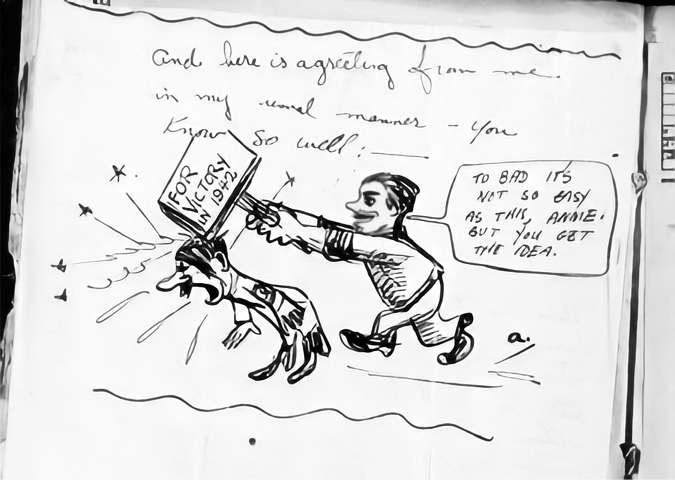
Figure 4. Cartoon by Avrom Yanovsky to Annie Buller, 1942.
Archives of Ontario, F 1405-85-65, mfn 462. Reproduced by permission from Dvoira and Kaethe Yanovsky.
Both Buller and Mills passed at least some of their time by advocating for their own liberation. For example, they each wrote to Mackenzie King on 22 December 1941 requesting release so that they might set their energies to aiding the Canadian war effort. They also sent copies of the letters to the Ottawa Citizen. In hers, Mills asked to be released to enable her “to make my contribution towards the defeat of Fascism.” Buller echoed these sentiments in her letter, writing, “My organizational ability in the working-class movement should be utilized in the present struggle against Fascism and it is my sincere desire to give my services to that end.” This letter also constituted one of Buller’s official requests for remission of her sentence.91 Not surprisingly, authorities quickly rejected it. “Thoroughly impregnated with Bolshevik philosophy which she has practised and preached over a long period and being a capable agitator, it is felt that release of Annie Buller at this time is not in the interests of national safety,” advised rcmp superintendent P. H. Tucker to the commissioner of the rcmp in Ottawa on 19 January 1942, almost seven months to the day the Soviet Union had joined the Allied cause.92
Her sentence completed, Mills seems to have been released sometime early in 1942. In spite of the conditions of her release, she immediately jumped back into party work in Edmonton, where she had relocated. She continued much of her wartime activism through the Alberta Communist Total War Committee and was a frequent public speaker at events. On 24 September 1942, Mills married William Halina Jr., a local activist with ties to the Edmonton Ukrainian Labour Temple and the cpc.93 Buller, then still incarcerated, scrapbooked a copy of an invitation to the wedding Mills had saved for her.94
Despite her physical absence, Buller’s activist presence continued to be felt in Communist circles, especially at concerts and political meetings. Often she dispatched passionate greetings from jail that were read aloud at events. To the ncdr’s February 1942 National Conference for Democratic Rights, she wrote, “I burn up with the desire to participate in the struggle to wipe off the scourge of Nazism from the face of the earth. I am sure the other interned and imprisoned anti-fascists feel the same way, for I know, as all others must, that this is our war, a war of all the Canadian people for the defense of our country, for the safety of our homes and our very lives.”95
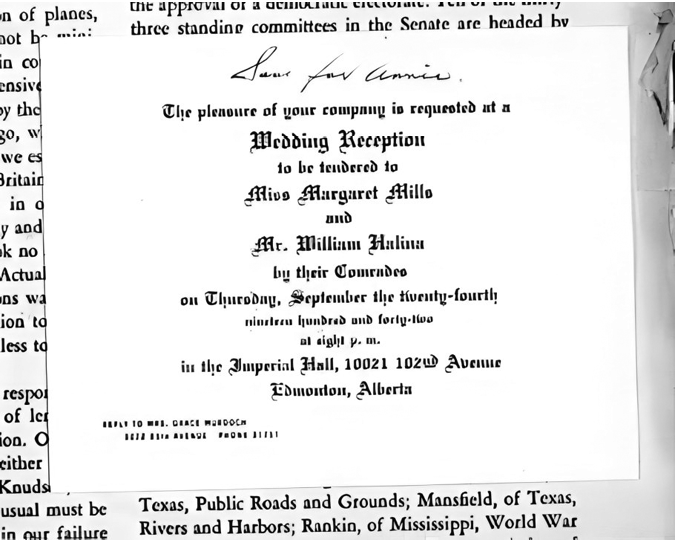
Figure 5. Wedding invitation for Annie Buller, 1942.
Archives of Ontario, F 1405-85-65, mfn 462.
The Road to Release
Buller’s sentence was supposed to extend well into 1943. However, by mid-1942, with the Soviet Union an ally, authorities’ justification for the continued incarceration of Communists had long disappeared. As Radforth notes, “more and more people saw the injustice of the case and were willing to declare their position publicly.”96 Pockets of support were increasing in various quarters. The ncdr managed to rally labour unions, churches, academics, and others. As its efforts intensified, it enjoyed success, helping bring about the release of a good number of the prisoners by the summer of 1942.
Helpful to the cause was the expansion of civil liberties activism during the war, with new groups established in Winnipeg, Vancouver, and Toronto to challenge the threat the docr posed. This did not mean these groups were pro-Communist; indeed, as Whitaker demonstrates, “some of the civil liberties groups tried to maintain respectability by eschewing Communist membership or support.”97 Nor did they tend to explicitly stand up for the labour prisoners, according to Ross Lambertson.98 While not on side, then, with the Communist Party per se – with the exception of the Montréal group, which had formed in the 1930s to protest the anti-communist Padlock Law and thus had many cpc ties – their voices nonetheless contributed to a rising chorus of discord calling out the government’s actions generally on wartime freedoms.
The cause began attracting some unprecedented support. A case in point is the ncdr’s “We Stand for Freedom” open letter and petition campaign, which appeared as large advertisements in major Canadian daily newspapers. As usual, signatories called for the release of prisoners, cancellation of remaining internment orders, and lifting of organizational bans; they also demanded that authorities proceed with “the most energetic and immediate prosecution of all pro-fascist, fifth-column saboteurs and their organizations.”99 Among the campaign’s supporters were many church officials, union leaders, lawyers, professors, a handful of private citizens, and a number of elected politicians.100 These included some unexpected bedfellows. John Bracken, Manitoba premier and future head of the federal Progressive Conservative Party, and noted red-baiter Mitchell Hepburn, the Liberal premier of Ontario, along with several members of Hepburn’s inner circle, were perhaps the most prominent and surprising signatories. Hepburn claimed the value of the cpc to the war effort as his main motivation. Part of the campaign’s appeal may also have been the opportunity it offered Hepburn to needle his long-time political nemesis, Prime Minister King. “The wholesale arrest and internment under the powers vested in the Ottawa Government by the War Measures Act of prominent political and labor leaders has astounded those of us who believe in British Freedom and justice,” Hepburn insisted on the eve of a Toronto Civil Liberties gathering at Maple Leaf Gardens on 17 July 1942. Continuing, he asserted, “A total war effort is not possible so long as an autocratic political party in office abuses its extreme power and persecutes those who criticize its policies and record.”101
The chance to draw support from the popular Co-operative Commonwealth Federation (ccf) may have also moved Hepburn’s boosterism of the cpc, according to Cy Gonick. It was certainly a factor that persuaded some close to the prime minister, along with the stabilizing role that cpcers were attempting to play in the wartime labour movement. As Gonick notes,
[cpc leader] Tim Buck’s pledge of support to Mackenzie King in his pamphlet “A National Front for Victory,” and his promise that Communists would be a moderating influence in the trade union movement, did not go unnoticed. Norman Robertson, an advisor to Mackenzie King, suggested that for tactical reasons the Communists had “become a restraining rather than a revolutionary influence in trade union organizations” and should now be encouraged rather than suppressed. No doubt he also calculated that a renewed Communist Party could steal away some of the alarming support being gathered by the surging ccf.102
Political expediency, then, won some over. Increasingly, it seemed the only holdouts, as Whitaker has documented, remained – not surprisingly – the rcmp, the virulently anti-communist Catholic Church in Québec, the Québec wing of the federal Liberal Party, and C. D. Howe’s faction of Mackenzie King’s cabinet, pro-business and right-wing in its orientation.103
Against this backdrop, the ncdr launched an intensive campaign calling specifically for the release of Buller and the handful of others who remained incarcerated. In addition to keeping up the pressure with their usual activities, they rallied supporters to bombard government officials, including Prime Minister King and Justice Minister Louis St. Laurent, with letters, postcards, and telegrams.104 These did not go unnoticed. “I am getting quite a lot of correspondence concerning Annie Buller,” St. Laurent wrote to another official in early September 1942.105 Encouragement to free Buller also came from members of his own party. “I would urge very strongly that she be released from Portage Gaol now,” wrote Ralph Maybank, Liberal mp for Winnipeg South, to St. Laurent. “From all I can hear in Winnipeg the policy of lettings these ‘anti-fascists’ out is being well-received.”106 St. Laurent had tasked Harry Leader, Liberal mp for Portage, with visiting Buller when he was back in his riding during a parliamentary recess. Noting her record of good conduct in jail, Leader wrote to Mackenzie King: “She impressed me favourably. She appears intelligent, is a fervent Communist and as she pointed out so also is Stalin.”107
Given all this and the changed global and domestic political circumstances, St. Laurent and others seemed well disposed to put the matter to rest, especially to avoid any potential for bad publicity. How to do so in Buller’s case was complicated, though, as she could not simply be released from jail. The internment order issued for Buller at the time of her trial in 1940 as an “insurance policy” to guarantee her detention one way or another now proved a complication. It seemed her liberty could not be granted without the immediate triggering of that order. And if not handled carefully, this could reflect badly on authorities, a fact of which they seemed well aware. “It is self-evident that if, under present conditions, the [internment] Order for her detention is executed when she completes her prison term, that same will result in considerable unfavourable criticism,” rcmp commissioner S. T. Wood warned St. Laurent, urging him to seek an alternative approach.108
They and many others in the federal Liberal Party and rcmp circles cast about for politically expedient face-saving solutions to dispense quickly and quietly with Buller’s case, while still maintaining an illusion of government authority and justice served. Some suggested releasing Buller but forcing her to stay in Winnipeg; others lobbied for a circumvention of the internment appeals process entirely.109 St. Laurent settled on quietly executing the internment order in September, many months prior to the completion of her sentence, as sources suggest federal authorities had recently been doing in others’ cases. To this, Buller, following the process laid out by the docr, formally stated her objections. Receipt of her objections triggered a federal internment advisory committee hearing, which took place on 13 October 1942. The committee, characterizing Buller as “an unusually able woman filled with fanatic zeal,” concluded that she, “if released, would not constitute a danger to the State, at least as long as Canada and Russia are both fighting the Axis Powers.”110
And so, Buller was liberated – to much fanfare. In her diary, on the day she left jail, she recorded, “Was released from Portage la Prairie jail Saturday, Oct 24th, 1942 at 7 p.m. Took train to Winnipeg. Was met by a big crowd.”111 As a condition of her release, she had requirements to adhere to, including not participating in still illegal Communist Party activities. Despite this, like Mills and other leftist former political prisoners, she quickly threw her energies back into radical activism. Indeed, she hit the ground running; fewer than 24 hours after she bid farewell to the jailhouse, Buller took to the stage as one of the featured speakers at a Workers’ Election Committee nomination meeting in Winnipeg.112 Buller remained a formidable activist for the remainder of the war. She channelled her energies first into the Communist-Labour Total War Committee, which eventually absorbed the ncdr.113 She worked there until the founding in 1943 of the Labor-Progressive Party (lpp), the entity that replaced the cpc until the ban was finally lifted on 17 August 1945. She was elected to the lpp’s national committee.114 Buller maintained her activism in the decades that followed, a party stalwart until her death at the age of 77 on 19 January 1973.
Conclusion
Annie Buller was an outlier. A woman acting very publicly in a man’s world as one of the few – and quite possibly the top – female national leaders of the cpc, she stood out to state authorities like a proverbial sore thumb. She was vocal, dynamic, and unapologetic, which made her a moving but necessary and especially desirable target. She made choices and sacrifices that made her activism possible, allowing her to leverage her abilities and training while managing factors that her male counterparts need not have considered, like mothering and other responsibilities. While little evidence is available that addresses Buller’s domestic circumstances, clearly she was able to engage extended child care from comrades. Her husband Harry Guralnick, an activist in his own right, appeared a supportive partner of her need to live a very public activist life in cpc leadership. In her work and comportment, unlike most other female comrades, Buller seemingly moved comfortably in activist spaces and engagements traditionally defined as male, challenging and transgressing prescribed and proscribed notions of gender and female respectability, and she could not be ignored. All of this combined to mark her as an unusual figure on the Communist left.
Attacks from authorities only seemed to ramp up her resistance. She sealed her judicial fate when she spoke up in court, proudly declaring her continued membership in and allegiance to the banned cpc. Perhaps, however, knowing her case was hopeless, Buller leveraged the opportunity – and the mainstream newspaper coverage it offered – as a useful platform to further the party’s message to a wide and possibly receptive audience. Her seeming fearlessness and outspokenness – especially as a woman – made her a particularly dangerous voice, one that state authorities fought to intimidate and circumscribe, ultimately failing all but temporarily.
In her activities as a working-class activist and cpc leader, Buller’s experiences illustrate how processes of gender can intersect with radical politics and political policing. Her case reveals how the state used surveillance and informants during World War II to apprehend targets, anticipating – incorrectly, in this case – that Buller’s son, Jimmy, would lead them to his mother. After her apprehension, the state assured Buller’s incarceration by compounding criminal charges with an internment order: for her, as for a number of others, detention would be achieved regardless of a court’s verdict or the length of its sentence. Internment had the added advantage, from the perspective of the state, of denying the accused an opportunity to publicly state their case – an opportunity that Buller seized to assert her unwavering political commitment.
In prison, Buller maintained her contacts with comrades on the outside who mobilized to secure her release through organizations including the ncdr, successor to the cldl. In spite of Canada’s shifting relationship with the Soviet Union, Buller remained in prison until late 1942, when an increasingly vocal and widespread campaign pressured the federal government to free her. Her story demonstrates how those targeted, and their community, responded to repression in order to defend their rights and freedoms. Ultimately, Buller’s case and the movement to liberate her and the other incarcerated members of the Communist Party and allied organizations illustrate the power of grassroots activism in challenging oppressive systems.
As a woman and a party leader, Buller’s carceral circumstances were unique among the female and male cpc and party-aligned activists who were arrested and incarcerated via the Defence of Canada Regulations. But, as with most of them, her encounter with the wartime carceral state seemed only to steel her resolve, returning her to Communist Party life in no less than fighting form.
1. The Mid-West Clarion managed to continue publishing in Winnipeg despite the ban, which had successfully suppressed the party’s Toronto-based Clarion and Québec-based Clarté newspapers in November of 1939. Only in the weeks following the 5 March 1940 raid was the Mid-West Clarion finally suppressed. For a sense of this timeline and Annie Buller’s involvement in the Winnipeg paper, see Gregory S. Kealey and Reginald Whitaker, eds., rcmp Security Bulletins: The War Series, 1939–1941 (St. John’s: Committee on Canadian Labour History, 1989), 364–365. As Chris Frazer notes, “In January 1940, the cpc launched an unofficial paper, the Canadian Tribune, which carefully sought to maintain legal status…. [It] was briefly suspended only once” during the war but otherwise managed to continue until 1991. See Frazer, “From Pariahs to Patriots: Canadian Communists and the Second World War,” Past Imperfect 5 (December 1996): 11.
2. Buller was initially wanted on thirteen charges related to her participation in producing and distributing issues of the Mid-West Clarion “containing material, reports or statements intended or likely to prejudice the recruiting of any of His Majesty’s forces, … likely to be prejudicial to the efficient prosecution of the war,” and/or “intended or likely to cause disaffection to his Majesty, contrary to Regulation 39 A of the Defence of Canada Regulations.” Once the party was declared illegal in June 1940, added to her slate would be the charge of being a member of an illegal organization. See “Buller, Sylvia Ann, 1940–1941,” P3144/4, Joseph Zuken fonds, Archives of Manitoba (hereafter, Zuken fonds).
3. For a detailed discussion of the party’s Popular Front ideals as they relate to women, womanhood, and family, consult Nancy Butler, “Mother Russia and the Socialist Fatherland: Women and the Communist Party of Canada, 1932–1941, with specific reference to the activism of Dorothy Livesay and Jim Watts,” PhD diss., Queen’s University, 2010.
4. Joan Sangster, Dreams of Equality: Women on the Canadian Left, 1920–1950 (Toronto: McClelland and Stewart, 1989), 158.
5. Exact numbers are difficult to establish and a feat beyond the scope of this paper. Ian Radforth has noted about 100 Communist internees, while Reg Whitaker suggests there were around 133. See Radforth, “Political Prisoners: The Communist Internees,” in Franca Iacovetta, Roberto Perin, and Angelo Principe, eds., Enemies Within: Italian and Other Internees in Canada and Abroad (Toronto: University of Toronto Press, 2000), 194–224; Whitaker, “Official Repression of Communism during World War II,” Labour/Le Travail, 17 (1986): 135–66.
6. Generally speaking, women criminalized and incarcerated under the Defence of Canada Regulations were few in number. In all, around twelve Communist or pro-Communist women served time. These women are Angela Dubé and Yvonne Richard from Québec; Ella Gehl, Jane Kenilworth, Gladys MacDonald, Susie Slavkowsky, and Flo Theodore, arrested in Saskatchewan; and, picked up in Manitoba, Ida Corley, Margaret Mills, Edna Shunaman, Bertha Smith, and of course, Annie Buller. Less prominent than most of the male prisoners – Annie Buller excepted – these women’s circumstances are difficult to document through available sources. What made them vulnerable to arrest, as I note elsewhere, was paid party work: “sometimes (though relatively rarely) as organizers … but more often … [in] ‘support’ roles that made them responsible for the preparation for distribution (or actual distribution, via the act of mailing) of illegal materials.” Being caught in possession of the materials was often enough to land one behind bars. Gladys MacDonald was the only Communist woman actually interned; this came about upon her completion of time served in Saskatchewan’s Battleford Gaol, to which she was committed via court conviction for violating the Defence of Canada Regulations. These women’s stories, Buller’s included, were absent from much of the internment literature, seemingly because they had a different legal and carceral trajectory than the majority of their male counterparts, who did their time in internment facilities. See Hinther, “‘Likely to Be Hampered and So She Prepared for the Worst’: Far Left Women and Wartime Political Incarceration,” in Rhonda L. Hinther and Jim Mochoruk, eds., Civilian Internment in Canada: Histories and Legacies (Winnipeg: University of Manitoba Press, 2020).
7. For discussions of a host of internment episodes in Canada illustrating this carceral trajectory over the 20th century, see the collected essays in Hinther and Mochoruk, eds., Civilian Internment in Canada. For a recent treatment of Japanese Canadian internment and the fight for redress, see Art Miki, Gaman – Perseverance: Japanese Canadians’ Journey to Justice (Vancouver: Talonbooks, 2023).
8. Mona Oikawa, “Conclusion,” in Cartographies of Violence: Japanese Canadian Women, Memory, and the Subjects of the Internment (Toronto: University of Toronto Press, 2011), 313. See also Oikawa, “Connecting the Internment of Japanese Canadians to the Colonization of Aboriginal Peoples in Canada,” in Rick Riewe and Jill Oakes, eds., Aboriginal Connections to Race, Environment, and Traditions (Winnipeg: University of Manitoba, 2006), 17–26, 20.
9. State targeting of the Communist and pro-Communist left during World War II was itself a part of a long trajectory of persecution of this activist community in Canada that extended from before World War I into the Cold War era. See Kassandra Luciuk, “Reinserting Radicalism: Canada’s First National Internment Operations, the Ukrainian Left, and the Politics of Redress,” in Hinther and Mochoruk, eds., Civilian Internment in Canada, 49–69; Reg Whitaker, Greg Kealey, and Andrew Parnaby, Secret Service: Political Policing in Canada from the Fenians to Fortress America (Toronto: University of Toronto Press, 2010); Dennis G. Molinaro, An Exceptional Law: Section 98 and the Emergency State, 1919–1936 (Toronto: University of Toronto Press, 2017); Rhonda L. Hinther and Jim Mochoruk, introduction to Hinther and Mochoruk, eds., Civilian Internment in Canada, 1–21, 3–4; Frances V. Reilly, “Controlling Contagion: Policing and Prescribing Sexual and Political Normalcy in Cold War Canada,” PhD diss., University of Saskatchewan, 2016.
10. Included here under the cpc and allied leftists umbrella are “ethnic hall” socialist organizations such as the Ukrainian Labour Farmer Temple Association, the Finnish Organization of Canada, and several pro-Communist secular left Jewish organizations.
11. John English, “Defence of Canada Regulations,” in Gerald Hallowell, ed., The Oxford Companion to Canadian History (Don Mills, Ontario: Oxford University Press, 2004), 175.
12. Sangster, Dreams of Equality, 166.
13. John Manley, “‘Communists Love Canada!’ The Communist Party of Canada, the ‘People’ and the Popular Front, 1933–1939,” Journal of Canadian Studies 36, 4 (Winter 2001): 82; Rhonda L. Hinther, Perogies and Politics: Canada’s Ukrainian Left, 1891–1991 (Toronto: University of Toronto Press, 2018), 47.
14. Ian Radforth, “Political Prisoners,” 196; Ross Lambertson, Repression and Resistance: Canadian Human Rights Activists, 1930–1960 (Toronto: University of Toronto Press, 2005), 105; Whitaker, “Official Repression,” 138–139, 144.
15. Whitaker, “Official Repression”; Frazer, “From Pariahs to Patriots”; Radforth, “Political Prisoners”; Michael Martin, The Red Patch: Political Imprisonment in Hull, Quebec during World War II (Gatineau, Québec: M. Martin, 2007); Hinther, “‘Dear Kate! I Don’t Know How You Manage!’ The Ukrainian Left and WWII,” in Perogies and Politics, 103–132; Cy Gonick, “Underground, Imprisoned, and Interned,” in A Very Red Life: The Story of Bill Walsh (St. John’s: Canadian Committee on Labour History, 2001); Jim Mochoruk, “Collateral Damage: The Defence of Canada Regulations, Civilian Internment, Ethnicity and Left-Wing Institutions,” in Hinther and Mochoruk, eds., Civilian Internment in Canada, 70–96; Myron Momryk, “Ukrainian Internment during the Second World War: The Case of the Ukrainian Labour Farmer Temple Association and Peter Prokopchak,” in Hinther and Mochoruk, eds., Civilian Internment in Canada, 242–263.
16. Some examples of biographies, autobiographies, and personal accounts are Peter Krawchuk, Interned without Cause (Toronto: Kobzar, 1985); Krawchuk, ed., Reminiscences of Courage and Hope: Stories of Ukrainian Canadian Women Pioneers (Toronto: Kobzar, 1991); Krawchuk, “The War Years,” in Our History: The Ukrainian Labour-Farmer Movement in Canada, 1907–1991 (Toronto: Lugus, 1996); William Repka and Kathleen M. Repka, Dangerous Patriots: Canada’s Unknown Prisoners of War (Vancouver: New Star Books, 1982); Ben Swankey, “Reflections of a Communist: Canadian Internment Camps,” Alberta History 30, 2 (April 1982): 11–20; Roland Penner, “Transition, Turmoil, and Trouble (1939–1943),” in A Glowing Dream: A Memoir (Winnipeg: J. Gordon Shillingford, 2007).
17. See Michelle McBride’s pathbreaking “The Curious Case of the Female Internees,” in Iacovetta, Perin, and Principe, eds., Enemies Within, 148–170, which examines the cpc’s Gladys Macdonald and several other women internees, including pro-fascist ones. My recent article on Communist women political prisoners in World War II has also attempted to expand our understanding of how criminalized women were treated and experienced this period. See Hinther, “‘Likely to Be Hampered,’” which includes only minimal commentary on Buller.
18. For histories of the Communist Party of Canada that touch on this period, see Sangster, Dreams of Equality; Ivan Avakumovic, The Communist Party in Canada: A History (Toronto: McClelland and Stewart, 1975); Merrily Weisbord, “Total War” and “Underground,” in The Strangest Dream: Canadian Communists, the Spy Trials, and the Cold War (Montréal: Véhicule Press, 1994), 103–10; A. Grenke, “From Dreams of the Worker State to Fighting Hitler: The German-Canadian Left from the Depression to the End of World War II,” Labour/Le Travail, no. 35 (1995): 65–105; Varpu Lindström, From Heroes to Enemies: Finns in Canada, 1937–1947 (Beaverton, Ontario: Aspasia Books, 2000).
19. See Whitaker, Kealey, and Parnaby, “Keep the Home Fires Burning, 1939–45,” in Secret Service, 145–176; Daniel Robinson, “Planning for the ‘Most Serious Contingency’: Alien Internment, Arbitrary Detention, and the Canadian State 1938–39,” Journal of Canadian Studies 28, 2 (1993): 5–20; Reg Whitaker and Gregory S. Kealey, “A War on Ethnicity? The rcmp and Internment,” in Iacovetta, Perin, and Principe, eds., Enemies Within, 128–147.
20. On the Rand School, see “Guide to the Rand School of Social Science Records TAM.007,” accessed 8 March 2024, http://dlib.nyu.edu/findingaids/html/tamwag/tam_007/tam_007.html. For discussion of the Rand School and its significance, see Thomas Wirth, “A Beautiful Public Life: George D. Herron, American Socialism, and Radical Political Culture at the Rand School of Social Science, 1890–1956,” PhD diss., State University of New York at Binghamton, 2014; John L. Recchiuti, “The Rand School of Social Science during the Progressive Era: Will to Power of a Stratum of the American Intellectual Class,” Journal of the History of the Behavioral Sciences 31, 2 (1995): 149–161.
21. Anne Toews, “For Liberty, Bread, and Love: Annie Buller, Becky Buhay, and the Forging of Communist Militant Femininity in Canada, 1918–1939,” MA thesis, Simon Fraser University, 2009; Louise Watson, She Never Was Afraid: The Biography of Annie Buller (Toronto: Progress Books, 1976), reprinted online at https://www.socialisthistory.ca/Docs/History/Buller/AB01.htm; Sangster, Dreams of Equality; Joan Sangster, “Annie Buller,” in The Canadian Encyclopedia, published 24 March 2008, last modified 9 September 2019, https://www.thecanadianencyclopedia.ca/en/article/annie-buller; Women in World History: A Biographical Encyclopedia, s.v. “Buller, Annie (1896–1973),” accessed 8 March 2024, https://www.encyclopedia.com/women/encyclopedias-almanacs-transcripts-and-maps/buller-annie-1896-1973.
22. As devoted socialists, according to Buller’s biographer Louise Watson, “they chose the anniversary date of the Russian Revolution as their wedding day.” Watson, “Personal Sketches,” in She Never Was Afraid, chap. 4.
23. A concise overview of Guralnick’s biography and activism (developed via an rcmp lens) can be found in S. T. Wood, “Memorandum to the Right Honourable the Minister of Justice,” 12 May 1941, in “Harry Guralnick,” Records of the Canadian Security Intelligence Service, RG 146 (hereafter, csis Records), A201600204_2016-12-21_11-42-32, Library and Archives Canada, Ottawa (hereafter, lac). For a thoughtful and detailed account of the Canadian Jewish left’s history, consult Ester Reiter, A Future without Hate or Need: The Promise of the Jewish Left in Canada (Toronto: Between the Lines, 2016).
24. Watson, She Never Was Afraid; Sangster, Dreams of Equality; Toews, “For Liberty, Bread, and Love”; Sangster, “Annie Buller”; Women in World History, s.v. “Buller, Annie (1896–1973).” For a comprehensive discussion of Buller’s Bienfait legal woes, see Stephen Endicott, Bienfait: The Saskatchewan Miners’ Struggle of ’31 (Toronto: University of Toronto Press, 2018), esp. chap. 9.
25. Intelligence Bulletins No. 16 (5 February 1940) and No. 43 (28 May 1941), in Kealey and Whitaker, eds., rcmp Security Bulletins, 134, 354. The available rcmp security bulletins for 1940 and 1941 are rife with other mentions of the party’s underground activities.
26. “Tim Buck’s Hide-Out” (15 December 1942), in Kealey and Whitaker, eds., rcmp Security Bulletins: The War Series, Part II, 1942–1945 (St. John’s: Committee on Canadian Labour History, 1989), 32–33.
27. Gonick, “Underground, Imprisoned, and Interned,” 129–133.
28. John Boyd, interview by author, 22 July 2015; Boyd, “My 38 Years of Working Full Time in the Communist Movement 1930–1968,” in A Noble Cause Betrayed … but Hope Lives On: Pages from a Political Life (Edmonton: cius, 1999), chap. 1, https://www.socialisthistory.ca/Remember/Reminiscences/Boyd/B4.htm. Boyd managed to narrowly avoid arrest entirely, thanks to a case of mistaken identity. He and Gladys “spent most of the internment years hiding out in plain sight in Minnedosa, Manitoba,” where he had been dispatched to run the Co-op’s newly acquired creamery. For more about their life there, see Rhonda L. Hinther, “Internment Is a Family Affair,” in Stephanie Bangarth and Jennifer Tunnicliffe, eds., Revisiting Human Rights in Canadian History (Winnipeg: University of Manitoba Press, forthcoming).
29. Krawchuk, “Underground,” in Interned without Cause, https://www.marxists.org/history//canada/socialisthistory/Docs/cpc/WW2/IWC04.htm.
30. The search for Buller and the events of the day she was arrested are documented in her rcmp file; see “Annie Sylvia (Mrs. Harry) Guralnick (Annie Buller), Toronto, Ont. (form: Winnipeg, Man.),” csis Records, A201600180_2016-12-21_09-44-13, lac.
31. “Peter Krawchuk,” personal memoir, in Repka and Repka, Dangerous Patriots, 41.
32. The ycl was the Young Communist League, a communist youth organization. As Daria Dyakonova explains, “In 1922 the young people within the [Canadian communist] movement founded an organization for youth and children – the Young Workers’ League, renamed the Young Communist League in February 1923 – as a section of the Young Communist International (yci). The league was open to young people of both sexes between the ages of fifteen (later fourteen) and twenty-three.” Dyakonova, “‘Young’ and ‘Adult’ Canadian Communists: The Question of Nationhood and Ethnicity in the 1920s,” in Oleksa Drachewych and Ian McKay, eds., Left Transnationalism: The Communist International and the National, Colonial, and Racial Questions (Montréal: McGill-Queen’s University Press, 2019), 317–336, 318.
33. Report re Annie (Ann) Buller – docr, 7 January 1941, Department of Justice File, vol. 2, “Annie Sylvia (Mrs. Harry) Guralnick,” csis Records, A201600180_2016-12-21_09-44-13, lac.
34. Report re Annie (Ann) Buller – docr, 7 January 1941, lac.
35. Details on Harry Guralnick’s activities – and police pursuit of him – can be found in his rcmp surveillance file; see “Harry Guralnick,” csis Records, A201600204_2016-12-21_11-42-32, lac.
36. Jim Buller, obituary, Toronto Star, 21 November 2012, http://www.legacy.com/obituaries/thestar/obituary.aspx?pid=161171207#sthash.88EIzO4G.dpuf.
37. It seems, at least according to Annie Buller’s rcmp files, that Jim Buller went by “Jimmy Gorelnick” [sic] during his high school years. See Report re Annie (Ann) Buller – docr, 7 January 1941, csis Records, A201600180_2016-12-21_09-44-13, lac.
38. Vassil’s actual name was Louis Guberman, and he also went by the name of Vassilefsky. For some discussion of the history and activities of the iuntw, consult Mercedes Steedman, “The Promise: Communist Organizing in the Needle Trades, The Dressmakers Campaign, 1928 to 1937,” Labour/Le Travail, no. 34 (Fall 1994): 37–73; Jodi Geisbrecht, “Accommodating Resistance: Unionization, Gender, and Ethnicity in Winnipeg’s Garment Industry, 1929–1945,” Urban History Review/Revue d’histoire Urbaine 39, 1 (2010): 5–19; Stephen Endicott, “Sweatshops and Militancy in the Needle Trades,” in Raising the Workers’ Flag: The Workers’ Unity League of Canada, 1930–1936 (Toronto: University of Toronto Press, 2012), chap. 12.
39. Detective D. Nicholson to Chief Constable George Smith, 4 March 1941, rcmp file, Annie Buller, p. 39, A201600180_2016-12-21_09-44-13, lac.
40. Nicholson to Smith, 4 March 1941, lac.
41. “Re Harry Guralnick, Winnipeg, Man., Defence of Canada Regulations.,” 19 June 1942, in “Harry Guralnick,” csis Records, A201600204_2016-12-21_11-42-32, lac.
42. Nicholson to Smith, 4 March 1941, lac.
43. Annie Buller, as quoted in Nicholson to Smith, 4 March 1941, lac.
44. Nicholson to Smith, 4 March 1941, lac. See also Winnipeg Free Press (wfp), 1 March 1941 and 21 May 1941.
45. Buller’s rcmp file contains a complete list of her criminal convictions to 1942; see “Memorandum Re: Annie Buller (Mrs. Annie Guralnick),” rcmp file, Annie Buller, vol. 3, 1942–1943, p. 80, A201600180_2016-12-21_09-46-57, lac. For a detailed account of the miners’ strike and Buller’s role, consult Endicott, Bienfait. Louise Watson’s biography of Buller, She Never Was Afraid, also offers an overview of Buller’s career and activism.
46. These amounts in 2024 dollars are $193,000 and $386,000, respectively. “Inflation Calculator,” accessed 8 March 2024, https://www.bankofcanada.ca/rates/related/inflation-calculator/.
47. Report re Annie Buller, Harry Guralnick, Louis Guberman @ Vassil, and Jock McNeil, Winnipeg Manitoba, Defence of Canada Regulations, 20 March 1941, rcmp file, Annie Buller, p. 34, A201600180_2016-12-21_09-44-13, lac.
48. J. Petryshyn, “Class Conflict and Civil Liberties: The Origins and Activities of the Canadian Labour Defense League, 1925–1940,” Labour/Le Travail, no. 10 (1982): 39–63, 39.
49. As John Manley explains, “On 20 February 1932, Communist Party of Canada (cpc) general secretary Tim Buck and six political bureau colleagues — Sam Carr, Malcolm Bruce, Tom Ewan, A. T. Hill, John Boychuk, and Matt Popovic — began five-year jail sentences in Kingston federal penitentiary. They were accompanied by Tom Cacic, a minor Party functionary who had been in the wrong place at the wrong time when, precisely six months earlier, the Ontario government had netted the Party’s big fish, charging them under Section 98 of the Criminal Code of Canada with seditious conspiracy and membership of an illegal revolutionary organization.” Manley, “‘Audacity, Audacity, Still More Audacity’: Tim Buck, the Party, and the People, 1932–1939,” Labour/Le Travail, no. 49 (Spring 2002): 9.
50. C. Scott Eaton, “‘A Sharp Offensive in All Directions’: The Canadian Labour Defense League and the Fight against Section 98, 1931–1936,” Labour/Le Travail, no. 82 (Fall 2018): 61.
51. Petryshyn, “Class Conflict and Civil Liberties,” 61–62; Manley, “‘Communists Love Canada!,’” 65.
52. The rcmp were closely monitoring Smith’s movements and cldl activities in 1939 and 1940, building a case for its eventual ban. See Intelligence Bulletins No. 5 (20 November 1939), No. 15 (29 January 1940), No. 17 (12 February 1940), No. 18 (19 February 1940), and No. 25 (8 April 1940), in Kealey and Whitaker, eds., rcmp Security Bulletins…1939–1941, 60, 132, 145, 153, 190, 205–6.
53. A. E. Smith, All My Life: An Autobiography (Toronto: Progress Books, 1977), 203; Dorise Nielsen, foreword to They Fought for Labor – Now Interned! by Committee for the Release of Labor Prisoners (crlp) (c. Spring 1941), 3; “Mary Prokop,” personal memoir, in Repka and Repka, Dangerous Patriots, 96–117; “Jenny Freed,” personal memoir, in Repka and Repka, Dangerous Patriots, 173–175.
54. crlp, They Fought for Labor, 15.
55. Report re Annie Buller, Harry Guralnick, Louis Guberman @ Vassil, and Jock McNeil, 4 March 1941, 43, lac.
56. Report “Re: AE Smith – Toronto, Ont.,” 27 March 1941, rcmp file, Annie Buller, p. 55, Department of Justice File, A201600180_2016-12-21_09-54-06, lac.
57. Joe Zuken, interview by Doug Smith, c. 1984, tape 3 of 8, Doug Smith fonds, C399, Archives of Manitoba.
58. Annie Buller, as quoted in “Annie Buller Gets Two-Year Term,” wfp, 21 May 1941.
59. “Annie Buller Gets Two-Year Term,” wfp.
60. R. B. Graham, as quoted in “Annie Buller Given 24-Month Jail Term,” wfp, 21 May 1941. I am grateful to Anne Frances Toews for an email exchange we had during the summer of 2015 on Buller’s legal situation.
61. S. T. Wood, Secret Memorandum to the Right Honourable The Minister of Justice, 4 April 1941, and R. R. Tait to Chief of Remission Services, 23 January 1942, both in rcmp file, Annie Buller, vol. 2, 1932–1942, pp. 6, 48, A201600180_2016-12-21_09-44-13, lac. Federal authorities seem to have taken this precaution in the case of a number of high-profile leaders, including Gladys MacDonald, the men arrested with Buller, and several others.
62. “Re: Harry Guralnick,” J. L. Cohen fonds, vol. 30, file 2917: ncdr, Re: Internees General, lac; “Freedom Is Short for Harry Guralnick,” wfp, 20 June 1942; “Jacob Penner to Arrive Here on Wednesday,” wfp, 8 September 1942.
63. See Hinther, “‘Likely to Be Hampered,’” 160–161, on the John Weir and Bill Tuomi cases; “Mitch Sago,” personal memoir, in Repka and Repka, Dangerous Patriots, 188; “Comrades-All in Hull To-day,” The Red Patch, Organ of Hull Anti-fascist Internees (Hull, Québec, 1942), Bilecki Collection, Association of United Ukrainian Canadians Archive, Winnipeg; crlp, They Fought for Labor; Gonick, “Underground, Imprisoned, and Interned.”
64. I am grateful to Kirk Niergarth for helping to articulate this analysis.
65. This parallels circumstances that unnaturalized Communist and pro-Communist migrants could encounter in times of peace, further demonstrating the state’s attempts to use all possible weapons at its disposal to silence dissent. As Dennis Molinaro has demonstrated of the interwar period, deportation could be a consequence of political activism. Section 41 of the Immigration Act empowered authorities to deport unnaturalized political undesirables; similar to the docr, targets had little recourse to successfully challenge their detention and expulsion. See Molinaro, “‘Citizens of the World’: Law, Deportation and the Homo Sacer, 1932–1934,” Canadian Ethnic Studies 47, 3 (2015): 143–161. See also Barbara Roberts, Whence They Came: Deportation from Canada, 1900–1935 (Ottawa: University of Ottawa Press, 1988).
66. “Internments Proving Most Effective,” in Intelligence Bulletin No. 36 (26 August 1940), in Kealey and Whitaker, eds., rcmp Security Bulletins…1939–1941, 288.
67. See entries on 30 October 1940, Winnipeg Police Arrest Record Book, 1 December 1939–27 June 1941, Winnipeg Police Museum.
68. For more on Corley’s and Mills’ backgrounds, the circumstances of their arrests and convictions, and their activities following release, see Hinther, “‘Likely to Be Hampered.’”
69. Whitaker, “Official Repression,” 148.
70. Krawchuk, “22 June 1941,” in Interned without Cause, 80, 81.
71. Intelligence Bulletin No. 45 (19 July 1941), in Kealey and Whitaker, eds., rcmp Security Bulletins…1939–1941, 372–373.
72. Intelligence Bulletin No. 47 (30 September 1941), in Kealey and Whitaker, eds., rcmp Security Bulletins…1939–1941, 402–403.
73. “Drive Started for Release of Labor Men,” wfp, 7 August 1941, included as clipping in rcmp file, 00960-A0027260, ncdr, Toronto, Ont., Corresp. to 7-10-41 incl., p. 131, lac; A. E. Smith to J. M. Wilkinson, 20 October 1942, A. E. Smith fonds, United Church of Canada Archives, Toronto (hereafter, A. E. Smith fonds); Smith, All My Life, 205.
74. Sangster, Dreams of Equality, 166.
75. Bea to Annie Buller, 2 August 1955, Robert S. Kenny Papers, Ms coll 179, box 41, folder 9. I am grateful to Bethany Lepp of University of Toronto Special Collections and Jim Mochoruk for helping me locate specific primary sources related to Buhay’s wartime whereabouts.
76. Sangster, Dreams of Equality, 167.
77. Surveillance records on the ncdr are abundant. For some examples, see National Council for Democratic Rights – Winnipeg, Man., Corresp. to 5-3-42 incl., rcmp file, 02288-A0027308, lac; National Council for Democratic Rights – Montreal, Que., Corresp. to 1-4-42, rcmp file, 00776-A0027254, lac. Records exist for other centres in other provinces as well, including British Columbia, Alberta, and Ontario.
78. Intelligence Bulletin No. 47 (30 September 1941), in Kealey and Whitaker, eds., rcmp Security Bulletins…1939–1941, 402–403.
79. The source does not indicate Mrs. McNeil’s first name. Report “Re National Council for Democratic Rights,” 13 September 1941, 101, in National Council for Democratic Rights – Winnipeg, Man., Corresp. to 5-3-42 incl., rcmp file, 02288-A0027308, lac.
80. For examples of cldl tactics, see Petryshyn, “Class Conflict and Civil Liberties,” 51–53. For a discussion of the ncdr activities, see Smith, All My Life, 205–207.
81. For more on the ulfta and the foc and the impact of the ban, consult Edward W. Laine and Auvo Kostiainen, A Century of Strife: The Finnish Organization of Canada 1901–2001 (Turku: Siirtolaisuusinstituutti, 2016); Hinther, Perogies and Politics.
82. “Notes of Value,” n.d., A. E. Smith fonds.
83. For some examples, see Report on Commission of ncdr, ncdr Conference for Democratic Rights, 22–23 February 1942, and Toronto Defense Conference Plan of Action, 17 May 1942, both in A. E. Smith fonds.
84. On the ulfta’s interwar cultural, social, and political activities, and the impact of the ban on the ulfta and the confiscation and sale of some of its halls to nationalist Ukrainian organizations, see Hinther, “Dear Kate!”
85. Toronto Defense Conference Plan of Action, 17 May 1942, in A. E. Smith fonds; “Handicraft Shown of Interned Group,” Gazette (Montréal), 24 November 1941, in National Council for Democratic Rights – Montreal, Que., Corresp. to 1-4-42, p. 68, rcmp file, 00776-A0027254, lac.
86. “Report on meeting of Wednesday, September 10, 1941,” and “Re The Democratic Rights Council, 16-9-41,” in National Council for Democratic Rights – Montreal, Que., Corresp. to 1-4-42, pp. 114–115, rcmp file, 00776-A0027254, lac.
87. Conversation between mp Harry Leader and Portage La Prairie Jail Sheriff (unnamed), as described in a letter from Leader to William Lyon Mackenzie King, 7 September 1942, rcmp file, Annie Buller, p. 34, Department of Justice File, A201600180_2016-12-21_09-54-06, lac.
88. These materials are a critical part of the Annie Buller papers housed as component of the Jim Buller Textual Records, F 1405-85-65, mfn 462, Archives of Ontario, Toronto (hereafter, ao).
89. For more information on Yanovsky and his work, see David Frank, “Looking for Avrom Yanovsky: An Exploration of the Cultural Front,” Left History: An Interdisciplinary Journal of Historical Inquiry and Debate 22, 1 (2018), doi:10.25071/1913-9632.39371. I am grateful to Frank for helping me secure permission to use this image.
90. Buller, Annie, Notebooks, 39-01, file 9, Communist Party of Canada fonds, MG 28, IV 4, vol. 38, Microfilm Reel H-1604, lac.
91. Zuken to Department of Justice, Remission Services, 17 February 1942, in file “Buller, [Annie] Sylvia Ann,” P3144/4, Zuken fonds; Annie Buller to William Lyon Mackenzie King, 22 December 1941, and Margaret Mills to William Lyon Mackenzie King, 22 December 1941, as printed in the Ottawa Citizen, n.d., rcmp file, Annie Buller, vol. 3, 1942–1943, p. 86, A201600180_2016-12-21_09-46-57, lac. Buller’s lawyer, Joe Zuken, was at the time one of the few Communists on the Winnipeg school board. In 1961, he was elected to city council, where he served until 1983.
92. P. H. Tucker, Supt., to the Commission of the rcmp, Ottawa, Ontario, 19 January 1942, rcmp file, Annie Buller, p. 10, A201600180_2016-12-21_09-44-13, lac; P. H. Thibault to Zuken, 21 April 1942, in file “Buller, [Annie] Sylvia Ann,” P3144/4, Zuken fonds.
93. Halina ran under progressive banners in two federal and two Alberta elections between 1935 and 1945. Candidates, Canadian Elections Database, accessed 8 March 2024, https://canadianelectionsdatabase.ca/PHASE5/?p=0&type=person&ID=8548.
94. Buller, Annie – Papers, part of Jim Buller Textual Records, F 1405-85-65, mfn 462, ao; “Hear Margaret Mills,” Medicine Hat Daily News, 8 May 1943. Party activist and former internee Bill Tuomi’s rcmp file contains considerable information on Mills, as the two travelled in the same Alberta activist circles. For examples of her continued activism, see rcmp Intelligence Report, 10-12-42, Bill Tuomi rcmp file, p. 23, A201500408_2016-02-23_14-31-16, lac.
95. Buller to the ncdr All-Canadian Conference in Ottawa, 12 February 1942, rcmp file, Annie Buller, vol. 3, 1942–1943, p. 78, A201600180_2016-12-21_09-46-57, lac.
96. See Radforth, “Political Prisoners,” 215, 220; Whitaker, “Official Repression,” 146, 148–149, 165.
97. Whitaker, “Official Repression,” 161.
98. Lambertson, Repression and Resistance, 89–90.
99. “We Stand for Freedom,” Winnipeg Tribune, 24 July 1942. Other versions of the advertisement centred on calls to lift the ban on the party and related organizations. See “We Stand for Freedom,” Globe and Mail, 6 October 1942, 9.
100. “Petition Asks Ban Be Lifted by Government: Prominent Canadians Seek Recognition of Communist Party,” Globe and Mail, 2 October 1942.
101. “Hepburn Would Free Interned Communists as Matter of ‘Rights,’” Globe and Mail, 17 July 1942, 15.
102. Gonick, A Very Red Life, 147. For a concise overview of Hepburn and Mackenzie King’s ongoing feud, consult Larry A. Glassford, “Hepburn, Mitchell Frederick,” in Dictionary of Canadian Biography, vol. 18 (University of Toronto/Université Laval, 2003–), accessed 13 February 2024, http://www.biographi.ca/en/bio/hepburn_mitchell_frederick_18E.html.
103. Whitaker, introduction to Kealey and Whitaker, eds., rcmp Security Bulletins…Part II, 18.
104. A. E. Smith, ncdr, to Zuken, 29 August 1942, in file “Buller, [Annie] Sylvia Ann,” P3144/4, Zuken fonds. For a number of examples of this correspondence, see rcmp file, Annie Buller, Department of Justice File, A201600180_2016-12-21_09-54-06, lac.
105. Louis St. Laurent, Minister of Justice, to P. J. Anderson, 4 September 1942, rcmp file, Annie Buller, p. 65, Department of Justice File, A201600180_2016-12-21_09-54-06, lac.
106. Ralph Maybank to Louis St. Laurent, 14 September 1942, rcmp file, Annie Buller, vol. 3, 1942–1943, p. 56, A201600180_2016-12-21_09-46-57, lac.
107. Leader to King, 7 September 1942, lac.
108. S. T. Wood to St. Laurent, 15 August 1942, rcmp file, Annie Buller, vol. 3, 1942–1943, p. 73, A201600180_2016-12-21_09-46-57, lac.
109. C. Batch, Intelligence Inspector, to DCI, 13 September 1942, rcmp file, Annie Buller, vol. 3, 1942–1943, p. 58, A201600180_2016-12-21_09-46-57, lac; Leader to King, 7 September 1942, lac.
110. Recommendation of the Advisory Committee, 15 October 1942, rcmp file, Annie Buller, pp. 15–17, Department of Justice File, A201600180_2016-12-21_09-54-06, lac.
111. Diary, 1942, in Buller, Annie – Papers, part of Jim Buller Textual Records, F 1405-85-65, mfn 462, ao. See also Convict Ticket of Leave, rcmp file, Annie Buller, lac, vol. 3, 1942–1943, p. 45, A201600180_2016-12-21_09-46-57, lac.
112. rcmp Report re Workers Election Committee – Nominating Meeting (W’peg Civic Elections), 25 October 1942, rcmp file, Annie Buller, vol. 3, 1942–1943, p. 50, A201600180_2016-12-21_09-46-57, lac.
113. Following the release of the remaining prisoners in the fall of 1942, the ncdr’s activities continued unevenly across the country. Many supporters turned their energies to supporting the war effort and the cpc and its affiliated organizations by other means, and by 1943, most branches had wound down. On 2 February 1943, organizers vacated the ncdr’s national office in Toronto. The organization was officially disbanded in 1945. See “Re National Council for Democratic Rights, Central Branch, Toronto, Ontario,” in National Council for Democratic Rights – Subversive Activities in Toronto, Ontario, Corresp. from 2-2-43, rcmp file, p. 4, 01824-A0027290, lac; Report “Re National Council for Democratic Rights – Windsor, Ontario,” 27 March 1942, National Council for Democratic Rights – Windsor, Ontario, Corresp., rcmp file, p. 4, 02133-A0027298, lac; V. A. M. Kemp to the Commissioner, “Re National Council for Democratic Rights,” 17 February 1943, in National Council for Democratic Rights – Subversive Activities in Toronto, Ontario, Corresp. from 2-2-43, rcmp file, p. 9, 01824-A0027290, lac.
114. B. G., “Comrade, Annie Buller,” n.d., in Buller, Annie – Papers, part of Jim Buller Textual Records, F 1405-85-65, mfn 462, ao; Smith, All My Life, 212.
How to cite:
Rhonda L. Hinther, “‘Thoroughly Impregnated with Bolshevik Philosophy’: Annie Buller’s Incarceration and Canadian Political Policing during World War II,” Labour/Le Travail 94 (Fall 2024): 9–44, https://doi.org/10.52975/llt.2024v94.002.
Copyright © 2024 by the Canadian Committee on Labour History. All rights reserved.
Tous droits réservés, © « le Comité canadien sur l’histoire du travail », 2024.