Labour / Le Travail
Issue 94 (2024)
Note and Document / Note et document
“The Moving Past”: Early 20th-Century Canadian Archival Films about Work
Keywords: Ontario Motion Picture Bureau; Canadian Government Motion Picture Bureau; Canadian history; labour; archival film; early documentary film
Mots clefs : Ontario Motion Picture Bureau; Canadian Government Motion Picture Bureau; histoire canadienne; travail et syndicalisme; film d’archive; premiers films documentaires
When I graduated with an MA in history from York University in the early 1980s, I intended to work for a year before commencing a PhD in history. This never happened. Instead, I started working as a consultant, primarily, though not exclusively, in the labour movement. In many projects – for the Canadian Auto Workers, United Steelworkers of America, and several building trades unions – history was usually at the core of my approach to projects or issues I had been retained to address.
Good fortune allowed me to work on several projects that drew on archival photographs and moving images of work and working people. In 1987, I helped to make Turning Technology Around, a film about computerized technologies in the workplace from a labour perspective.1 The film was part of a series of projects undertaken for the Labour Council of Metropolitan Toronto that gave me access to many old factories. It showed that technology was not neutral but deeply political and required a response from labour beyond simple resistance. The research for this film took me to the Moving Image and Sound Archives, where I discovered the vast holdings of film and video stored at Library and Archives Canada in Ottawa.
In 1992, the Ontario ndp government created a modest funding program that supported a few labour history projects during its brief existence. That same year, an organization I called the Labour History Images Group, which had little more than letterhead to its name, applied for and received a grant to present a series of archival films about work. With those funds, I was able to fully explore the labour-themed films being held in the public archives.
I used the grant to pay for the editing of seven films and to commission Canadian musician and composer Allen Booth to create a soundtrack for each film. This collection of Canadian archival work films was titled “The Moving Past.” A public screening of the film anthology at the City of Toronto Archives in 1993 was well attended. John Bentley Mays, an arts reporter with the Globe and Mail, took an interest in the films and wrote a complimentary piece about the project.2 The publicity generated interest in the collection from around the world. I shipped more than 200 vhs tapes and, later, dvds to academics and universities from Sweden to California. As recently as last year, 30 years after the release of “The Moving Past,” a York University professor requested a copy of one of the films. The popularity of the film collection and my work on the board of the Ontario Workers’ Arts and Heritage Centre sustained my interest in labour history.3
For the recently launched Moving Past website, the films from my earlier project and others from Canada’s film archive were digitized.4 A number of these are sources of interest to historians of labour and the working class in Canada.
Films as a Source for Labour History
In Canada, historians interested in archival film are in a somewhat unique situation.5 In the early 20th century, while private companies had been making films here for a few years, Canada had two government-sponsored motion picture bureaus before any others had been created elsewhere in the world.6
In 1917, the Ontario Motion Picture Bureau (ompb) was created and operated out of the Office of the Treasurer. Its first director, S. C. Johnson, a graduate of the Ontario Agriculture College, was a “vegetable specialist.”7 Johnson, who had authored several books on farming, believed that motion pictures could be used to educate farmers who had no formal schooling.8 In the case of the ompb, the films were intended as “educational work for farmers, school children, factory workers and other classes,” and to “give instruction in all branches of agriculture, etc., fruit growing.” The ompb was also directed to “advertise the resources of the province and to encourage the building of highways and other public works, and other subjects if made more useful with motion pictures.”9 During the first four years of its operations, the ompb contracted film production to private studios. In 1923, the government purchased the studio and premises of an existing film company in Trenton, Ontario, that had closed. All the bureau’s films were produced from those premises after that.
The Exhibit and Publicity Bureau, the federal counterpart to the ompb, was created through an order-in-council in 1918 and was renamed the Canadian Government Motion Picture Bureau (cgmpb) in 1923. Operating out of the Trade and Commerce Department, the cgmpb was to “to advertise abroad Canada’s scenic attractions, agricultural resources and industrial development.” The films of the Canadian bureau were also shown at venues like the Canadian National Exhibition (cne), where large crowds watched the films and listened to lectures by the directors.10
As Peter Morris notes in his book on the history of Canadian cinema, the Canadian experience in early filmmaking was “remarkable,” and it is surprising that other governments did not recognize in quite the same way that film “is an efficient and effective medium for disseminating information.”11 Morris’ book, however, is concerned with the business of the industry and the aesthetics of these early films. He did not consider that they could be primary sources for labour historians, though a large proportion of them were about work and industry. Embattled Shadows does mention a few of the films that are discussed later in this essay, but Morris does not discuss what these films might reveal about work and perspectives on work.12
Interest in the work of both the federal and the Ontario government filmmaking bureaus, especially for non-theatrical productions, continued to grow. Screenings of the films of the ompb were attended by a reported 100,000 during the two-week cne in 1919.13 The province created an extensive distribution system to ensure its films were seen in various jurisdictions. There were 48 government representatives, equipped with projection cameras, whose purpose was to engage public schools, farmers’ clubs and institutes, and the ymca. Private theatres were also involved in the distribution of ompb films.14 Near the end of 1919, it was reported that over a million people had seen the bureau’s films.15
Both bureaus used the non-flammable safety stock Pathé-Freres 28mm format in their productions, making it easier for them to be screened. This type of stock, invented in 1912, was less flammable and more durable than the film stock being used by other companies. It may explain why so many productions have survived without proper archival storage. The projector required to screen this format was also well suited to “non-theatrical” uses in classrooms and community halls and easier to operate than the projectors required for other film formats. In 1920, it was predicted that in 25 years there would not be a school in Canada that did not have a film projector and “there would not be a teacher who did not know how to operate one.” Further, the expert announced, “There will be ‘text-films’ as well as ‘text-books.’”16
Public screenings of various films in theatres soon became commonplace in cities and towns.17 After 1925, the cne featured a special venue in which to view these productions. While theatrical productions stimulated interest in Canada and promoted tourism, the educational films produced by the film bureaus also played an important role.18 In that same year, the ompb had purchased the film collection of Pathéscope of Canada and was by then operating in its new Trenton film studio. Five thousand people a day saw the ompb films at the cne in 1929.19
The Canadian-made films also helped to combat “American propaganda” that was judged to be “un-British,” even “smutty.” Ongoing efforts were made to ensure that school-age children watched the films. For example, twelve theatres in Toronto were selected to show the films to school-age children in 1927. A committee of teachers selected the films for their appropriateness, expanding the program from a more modest effort the previous year.20 The chair of the ompb noted in 1930 that film “as an agency of instruction was beyond compare” and that “you can get more in a motion-picture in ten minutes than you could say in class in an hour.”21 Advocates of the films in schools noted that between 200 and 400 students could watch the films at a time, and they were very well behaved while doing so. Any group could borrow any film at no charge other than the transportation costs.22 This industry, it was noted, “has a great potentiality.”23
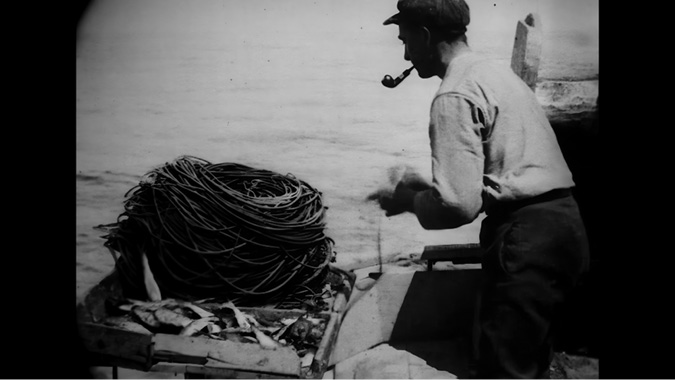
Figure 1. A pipe-smoking fisher prepares the “skates” for the line.
Fresh from the Deep, item no. isn 199415, lac.
These Canadian films were also seen by large audiences outside of Canada. Several films were shown to visitors at the 1926 auto show in New York City, resulting in inquiries from more than 200,000 potential tourists from all over the United States.24 Conferences in the US also featured the films. Delegates at the American Society for the Advancement of Science, for instance, held in Washington, DC, in 1924, viewed “pictures of scenes of nature, resources and industry from the Dominion.”25
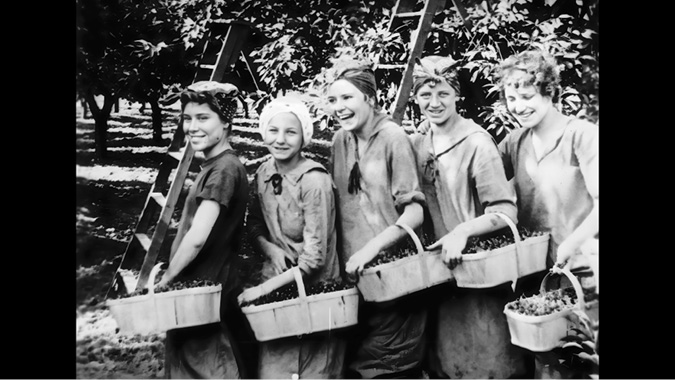
Figure 2. The “farmerettes,” baskets full, enjoy their work and make some extra money.
Where Nature Smiles, item no. isn 201473, lac.
The films of both bureaus assisted in building “social identities” based on messages about nature and the triumphs of industrial development. The stories told by some of the films also instructed audiences in proper behaviour. Here, the context of World War I and its aftermath was significant. During the war, fundraising and war bond drives employed films to motivate their audiences. Their effectiveness did not go unnoticed.26 Demand for Canadian-made newsreels about Canada’s troops overseas further alerted the government that audiences were interested in Canadian content.27 There was already concern that the US film industry was developing quickly, and that millions of dollars were being spent importing American films into Canada.28 These made-in-Canada films sought to form better citizens while attracting foreign capital and investment in Canada. “It was the duty of every Canadian,” declared the Globe, “to see these wonderful pictures about their very own Canada.”29
As large numbers of veterans returned home after the war, many were re-deployed in agriculture and industry. The instructional films of both motion picture bureaus also played a role in their re-integration, serving as introductions to various forms of work. They were useful for socialization as well as entertainment. Many veterans returned more politically active. Events such as the Winnipeg and other general strikes across the country threatened the authorities and the business community. The narratives of these educational films sought to steer these returning veterans away from organizing and radicalism. For example, unions are invisible in the films that feature industries in which unions were actually active. Labour’s resistance to work reorganization, technology, low wages, or harsh working conditions never appears in these productions. Indirectly, however, the films have a lot to say about these issues.
Along with radio broadcasting, which also expanded dramatically at that time, the motion picture bureaus in Canada exemplified a major shift in cultural production. The state sought to influence how people thought about things directly, not just in the subject matter of the films that were made, but in the manner, content, and ideology that served as their foundation.
Yet both bureaus had committed to film technologies that were designed for silent filmmaking. The popularity of cgmpb films slowly faded away. The federal motion picture bureau continued to make silent films into the mid-1930s even though it was provided with funding for sound equipment. Its films also experienced distribution problems. The legacy of the cgmpb disappeared gradually. Over 5,500 films from the Canadian bureau remained in circulation, being shown in places such as the “unemployed camps” across the Dominion.30 But audiences eventually lost interest in them. The cgmpb was formally closed in 1941 and replaced by the National Film Board.31
The ompb was abruptly closed in 1934 by the provincial government under Mitchell Hepburn in a cost-cutting move. “There’s no sense in making silent films and bad ones at that,” said the premier.32 All the films and records of the Ontario bureau were ordered destroyed, so it is somewhat miraculous that they survived. Instead, they were stored in barn near North Bay and discovered 30 years later.33
The Films and Labour Historians
The films produced by both bureaus were widely viewed and had an important influence on Canadian perceptions and perspectives. Their popularity suggests they are, therefore, valuable historical sources, complementing published scholarship and other primary sources. Many of the films are of particular interest to historians of labour and the working class, even when they need to be read against the grain of their intended didactic narratives. These films are also useful for their innovative approaches to teaching history.
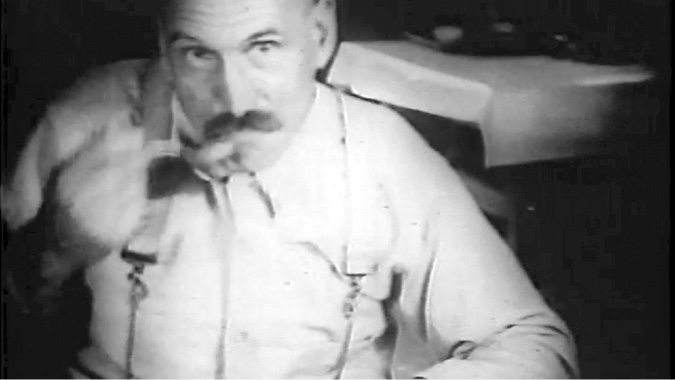
Figure 3. A miner enjoys a delicious meal at the end of his shift.
Life in a Mining Camp, item no. isn 185314, lac.
The lac film collection of the output of both the ompb and the cgmpb contains more than 1,000 films. Best farming techniques, celebrations of industrial technology, scenic vacation spots for the leisure class, “fair treatment” of immigrants to Canada, and appropriate workplace behaviour are just some of the subjects covered. Fifteen of the bureaus’ films are now available to stream on “The Moving Past” website (https://www.themovingpast.com/). I will highlight here the ways in which the films intersect with Canadian labour and working-class historical research and teaching.
The films that comprise “The Moving Past” illustrate themes and perspectives about work, industry, and values through the lens of the state. Work and the production process in mining, auto manufacturing, construction, and other industries are depicted in the industrial documentaries, including Your Future Car, Silver Mining in Ontario, and A Story of Stone. Life in a Mining Camp portrays mining work as an easy means of attracting factory workers to mining camps in a manner that seems comical today.
Fruit picking and jam production are the subject of Where Nature Smiles. Fresh from the Deep, a cgmpb production, shows how halibut caught off the coast of British Columbia are sent for canning and then shipped by rail to central Canada and the US. The promotion of tourism in Georgian Bay to the well heeled is the purpose of A Region of Romance, which offers an uncritical narrative that acknowledges that cottage country was built on Indigenous land. The Indigenous fishing guides portrayed in When Summer Comes seem to play a central role in making fishing a key attraction.
Three films – Her Own Fault, Someone at Home, and Mailing Trouble – are more complex character-driven narratives that explore gender roles, work safety, and class, in the context of work and technology. Each tells stories that explore masculinity and class in the context of new technology.
A brief discussion of the films, connecting them to historical scholarship where possible, follows. Themes overlap in the content of many of the films, but these brief descriptions will give the reader an idea of what each film conveys.
Manufacturing an 8" High Explosive Howitzer Shell (1918, cgmpb)34
Shell factories during World War I introduced unprecedented levels of mechanization to the metal industry. Just a couple of years before this film was made, machinists staged a series of strikes, opposing the deskilling and work intensification that threatened their work. Yet these struggles are absent in the film’s detached, sublime depiction of the technology needed to make a shell. In each scene, the worker is tending a machine. Labour seems to be at the service of technology, an employer’s dream, presented in this government-sponsored film made at the John Bertram & Sons Works in Dundas, Ontario. The film is an interesting epilogue to the labour struggles that Myer Siemiatycki and Craig Heron describe in their work.35 Given how soon the film was made after those labour struggles, one wonders if it did not help employers “rub in” what was, in the end, a defeat for metalworker unions.
Silver Mining in Ontario (1919, ompb)36
This documentary provides a detailed look at silver mining in the Cobalt, Ontario, area. The work of an underground miner is shown in some detail. The film captures some of the environmental impact that mining had on the area. Inclusion of the value of what is mined reflects the enormous wealth that was extracted from this region. Northern Ontario was the location of extensive mining during this time, and the business class raved about the fortunes that were made.37
Life in a Mining Camp (1921, ompb)38
The film follows two men, “Smith” and “Jones,” who are working at a Toronto factory when it shuts down for the winter. They are soon hired at a mining camp, where working and living conditions appear to be easy and comfortable. The portrayal of the industry’s safe and easy conditions seems at odds with what historians have written about mining in this region and era. The film suggests miners enjoyed high wages and wholesome living conditions, freed from hard labour through mechanization. It’s doubtful this film would have encouraged anyone to head up to the mines, where workers were likely to surmise that reality was a little different.39
Where Nature Smiles (1921, cgmpb)40
Fruit production in the Niagara region is featured. Young women dubbed “farmerettes” love the job of fruit picking. Their demeanour suggests nothing of the exploitation discussed in Carmela Patrias’ work on the Niagara fruit region in the period.41 Fresh fruit is sold at market, while some of it is processed into jams, which in turn are sold throughout the region in various venues. A government refrigeration facility is referred to, raising interesting questions about how the state supported this industry.
Your Future Car (1922, ompb)42
This film was shot at Durant Motors in Leaside, then a suburb of Toronto. Technology and the organization of production varied significantly between plants and manufacturers in this period, when the industry was still relatively young. This record of production is sufficiently detailed to document hazards and capture how the organization of work was based on gender and age. For example, the upholstery department featured in the film is comprised entirely of women. Both Taylorism and craft methods coexist in the same factory. Just a few years after this film was made, the union sought to organize factories in this industry.43 The plant was eventually absorbed by Frigidaire in 1937.
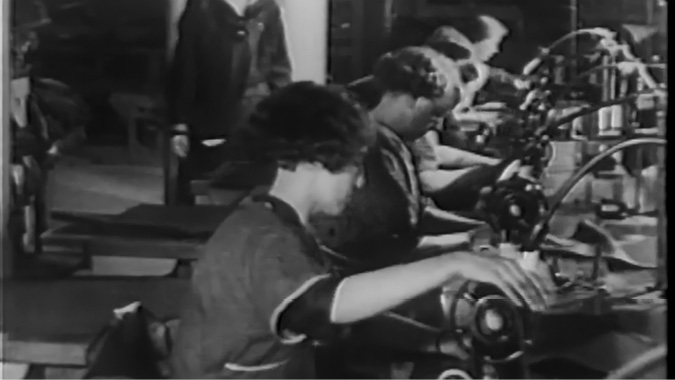
Figure 4. The upholstery department is the only place where women are employed in the Durant Motors automobile factory.
Your Future Car, item no. isn 185644, lac.
Speeding Up Your Business (1922, ompb)44
While the film refers to “business,” the location of the story is the postal service, at the central sorting station at the foot of Bay Street in Toronto. “Speed” and “efficiency” are important for a successful business, the film says. It features conveyors that assist in the sorting and movement of mail, with the employees working to the pace of the conveyors. This technology had broader applications beyond postal work. Just a few years later, the postal workers featured in the film were on strike.45
Fresh from the Deep (1922, cgmpb)46
Using herring as bait, fishers catch halibut in a large area off the coast of British Columbia, from the Strait of San Juan de Fuca all the way to Kodiak Island in Alaska. Fishers in boats of six to twenty men then bring their haul onto a larger “mother ship” to be processed in factories in Prince Rupert. About 90 tonnes are processed daily. The fish is packed in crates with ice and loaded into refrigerated train cars – the “Fish Express” – where it travels to central Canada and the United States for sale.47
A Story of Stone (1924, ompb)48
This production captures the stone construction of what is now called the Whitney Block, part of the government of Ontario buildings at Queen’s Park. While the film explores the theme of the “ancient trade of stone masonry,” it shows a high level of mechanization throughout the construction process, from quarrying at Queenston, in Niagara, to cutting the stones into massive slabs for the building’s walls to finally carving the stone over the entrance, which requires pneumatic chisels that still appear to require manual precision.
The Drive (1925, ompb)49
Felled timber is taken down the Mattagami, a Northern Ontario river. The men who guide the logs on “the drive” are “famous for their dexterity,” as poling and burling are demonstrated. In an amusing sequence, the men are described as “proverbial for their appetite”: one has allegedly eaten a ten-pound bologna, while another consumed 45 eggs, shells and all. The independence that the workers seem to enjoy in the film reflect what Ian Radforth’s history of the industry describes.50 The cutting of the logs into planks and boards comes next. The product eventually finds its way to a lumberyard in Toronto to be sold. Ontario’s “treasureland” of forest, mines, and streams helps make Canada prosperous, the film concludes.51
When Summer Comes (1922, ompb)52
The government of Ontario sought to promote the province to tourists and “sportsmen” by featuring its abundant lakes, forests, and fish. “Native lore” is used to explain the beauty of the Thousand Islands region. The ease of travel to this wilderness is communicated to wealthy travellers in Canada and the United States. Georgian Bay offers welcoming hotels and lodges. The accommodation is comfortable and the food is delicious. Indigenous guides, using their “instincts,” help guests catch fish. This racist trope, along with a disturbing image of a Black woman, illustrates attitudes of this era through a government-sponsored film.53
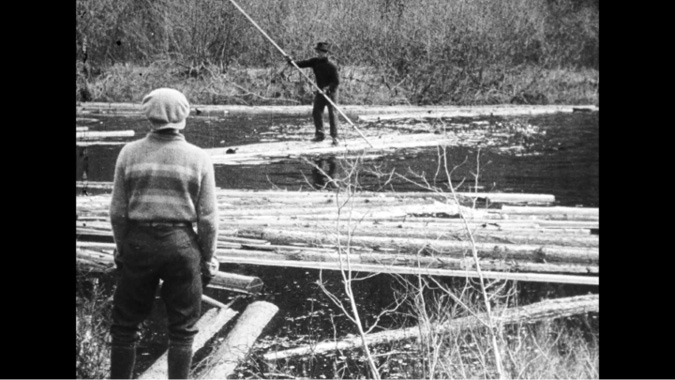
Figure 5. A driver “poles” down the river on a log.
The Drive, item no. isn 21484, lac.
A Region of Romance (1927, cgmpb)54
A promotional portrayal of cottage country in the Huntsville area of Ontario, the film acknowledges this was Indigenous land. Visitors travel on boats called Algonquin and Iroquois. Cottagers enjoy various activities on water and land, such as tennis, horseback riding, and lawn bowling. An Indigenous man, said to be the grandson of the local chief, in full headdress, visits the lodge by canoe. He greets the well-dressed guests, shaking hands. The Indigenous “visitor” is invited to play golf and appears to be impressed with the “palatial hostels of the white man” that have been erected on what was once his land.
The Educational Playground (1922, ompb)55
The social control of children was a growing concern in the 19th- and early 20th-centuries.56 This film opens with young children playing on the sidewalk, unsupervised.57 To ensure a healthy environment, and to avoid “criminal propensities” in school-age children, several playgrounds and recreation centres were funded by a private philanthropist. The film shows how children are supervised and engage in various activities, receiving instruction in various crafts, skills, and games, organized by age and gender.58 Folk dancing is judged appropriate for the girls; they develop “rhythm and grace.” So too are weaving and sewing. Boys engage in more boisterous and competitive games such as “blindfold boxing.” As the film explains, British children take to these games “instinctively.” Those with foreign parentage develop a love of sport, fair play, and manliness, “which mean so much to a country.” Over a million children participated in the program in the decade ending in 1921.
Her Own Fault (1922, ompb)59
The plight of young, unmarried working women was a concern in the growing cities of the early 20th century.60 This film, part of the original 1993 anthology “The Moving Past,” may be better known to labour historians. A morality play, it stars a “good” factory girl and “bad” factory girl, both employed making heels for shoes at the Gutta Percha Rubber Factory in Parkdale, Toronto. The girl who is promoted to “forelady” is also rewarded with a budding relationship with her male supervisor. The “bad” girl “does less each day” and contracts tuberculosis.61 The film reflects the growing concern that young, unmarried women working in cities would be tempted by the vices that urban life offered.
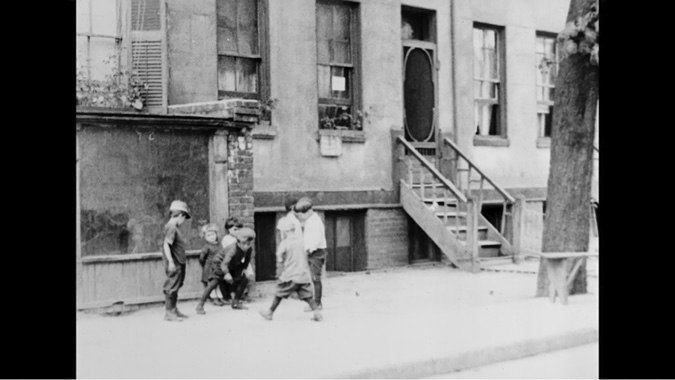
Figure 6. Unsupervised children play on the sidewalk – a threat to the social order.
The Educational Playground, item no. isn 192038, lac.
Someone at Home (1925, ompb)62
The theme here is that injuries and fatalities are a serious issue at an electrical utility.63 A lineman named Jim is planning to marry on this day but “won’t take safety seriously.” A bachelor who lives in a boarding house, he is late for work. The more fastidious and conscientious worker is married, has two children, and is very safety conscious – a comment on class and respectability. When an automobile knocks out an electrical pole, power is cut to the hospital, imperilling the life of a little girl. Jim is dispatched to restore the power and is seriously injured. Not taking safety seriously almost costs Jim his fiancée. The film ends with a one-word message: “Think!” It is implied that fatalities and accidents occur because of worker carelessness.64
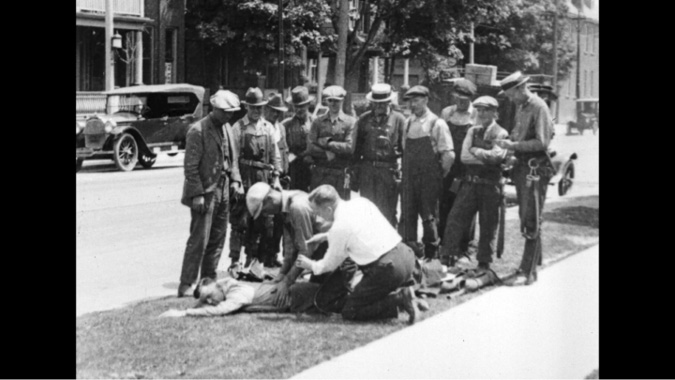
Figure 7. Linemen practise life-saving techniques in the event of an electrocution.
Someone at Home, item no. isn 108889, lac.
Mailing Trouble (1929, ompb)65
The sudden death of Thomas Stanley, a successful but extravagant man, leaves his wife, son, and daughter in difficult circumstances. They search for boarders to help make ends meet. What follows is a morality tale about the importance of properly addressing letters and parcels. The consequences of not doing so are wide reaching and, in some cases, extreme. For example, Frank, the late Mr. Stanley’s son, improperly addresses a letter soliciting work from the father of his fiancée. Without a job, Frank nearly loses his fiancée, but everything works out in the end.66 This film operates at many levels; addressing letters and parcels accurately was no doubt important to the efficiency of the post office. But the requirement that Frank have a job to be part of a couple says something deeper about masculinity and gender relations at the time.
Conclusion
These early Canadian films should be recognized as a useful source for historical research and teaching. Often didactic in tone, the films sought to educate and instruct their audience or promote a cause or idea. They provide insights into state interventions into education and culture at a time when mass communication was emerging. Today, however, they are virtually unknown and little used by historians.67 There are several reasons for this, which “The Moving Past” archival film website seeks to remedy.
Generally, the films are difficult to access, as very few have been digitized. The archive’s catalogue is not well suited to researching the films. There are also costs related to their transfer from the original film, and copyright is unclear with some productions. In some cases, the film might also be in poor condition or incomplete, which one only discovers once the film is paid for and sent. The research process, from consulting the catalogue to receipt of the order, can take several months.
As an antidote to these problems, the films available on “The Moving Past” website stream in high definition and are easy to access. The films that have been selected are complete and in good condition. Understandably, films made a century ago were paced for audiences at that time. Viewing the films in their original format can be challenging, especially for students accustomed to fast-paced videos with thumping soundtracks. The productions move very slowly by contemporary standards. “The Moving Past” has addressed this “viewability” issue by editing the films to reduce the length of the shots and quicken their pace, without compromising the integrity of the content. No scenes have been removed, and the narrative sequence of each film is unaltered. A musical soundtrack has been added to each film using two approaches: most of the first seven films, originally edited and curated in 1993, feature commissioned music; the second group of eight films, curated more recently, features period music from the 1920s carefully selected to match the film’s subject matter and synced to the visual narrative.
To subscribe, visit “The Moving Past” website (https://www.themovingpast.com/). Subscriptions will finance the addition of more films and support the cost of operating the site. Questions may be directed to themovingpast@gmail.com.
1. Turning Technology Around, film, David Hawkins, dir., David Sobel and Susan Meurer, scriptwriters (Toronto: Labour Council of Metropolitan Toronto, 1987).
2. “Toil and Sweat beneath the Bricks” Globe and Mail, 5 May 1993, C3.
3. See the Workers’ Arts and Heritage Centre website: https://wahc-museum.ca/.
4. The films selected for streaming were made between 1918 and 1929 and vary in length from four to fifteen minutes. These silent black and white productions feature intertitle cards that communicate dialogue and other information. They are carefully stored at the Library and Archives Canada (lac); nonetheless, they are deteriorating and are difficult to access.
5. I am referring to English Canada. A 1967 fire at the National Film Board in Montréal may explain the absence of French-language films that were made in the period. See Andrew H. Watts, “Orphaned in the Archive: The Library and Archives Canada 28mm Film Collection,” MA thesis, Ryerson University, 2019, 25.
6. Peter Morris, Embattled Shadows: A History of Canadian Cinema (Montréal: McGill-Queen’s University Press, 1978), 128–129.
7. “Bureau of ‘Movies’ Opened by Province: Will Use Them to Spread Information,” Globe, 23 May 1917, 8.
8. Morris, Embattled Shadows, 137.
9. “Bureau of ‘Movies’ Opened,” 8.
10. “Tour All Canada with Movie Man,” Globe, 2 September 1919, 9.
11. Morris, Embattled Shadows, 127.
12. Morris, Embattled Shadows, 156.
13. “Ontario Government, ‘Movie’ School Boon to Farms,” Globe, 29 November 1919, 7.
14. “Ontario Pictured upon the Screen,” Globe, 30 August 1919, 5.
15. “Ontario Government, ‘Movie’ School,” 7.
16. “Motion Pictures in Every School,” Globe, 31 January 1920, 7.
17. Morris, Embattled Shadows, 151–152.
18. See Dominique Brégent-Heald, “James Oliver Curwood: Advertising Canada across the Border,” Journal of Canadian Studies/Revue d’études canadiennes 52, 3 (2018): 691–717.
19. “Movies of Ontario Shown at Exhibition,” Globe, 27 August 1929, 6. The films were also shown at the Royal Winter Fair; see “First Showing Ontario Government Motion Picture films,” advertisement, Globe, 20 November 1928, 2.
20. “Movies for Children Shown This Morning,” Globe, 12 February 1927, 15.
21. “Censor Foresees All-British Films Ousting US Ones: Major Boylan,” Globe, 15 August 1930, 10.
22. Wyndham Wise, “A History of Ontario’s Film Industry 1896–1985,” Take One, no. 28 (Summer 2000): 22.
23. “Educational Film Industry Highly Developed in Canada,” Globe, 13 August 1918, 12.
24. “Auto Show Visitors Learn of Ontario: Huge Throng of Probable Tourists,” Globe, 23 January 1926, 7.
25. “Canadian Delegates to Attend in Force US Science Meeting,” Globe, 25 December 1924, 5.
26. Gerald G. Graham, The Birth of Canadian Film Technology (Newark: University of Delaware Press, 1989), 57.
27. Watts, “Orphaned in the Archive,” 19.
28. “Canadians Purchase Movie Films in US,” Globe, 8 May 1917, 15.
29. “A Lecture with Moving Pictures,” Globe, 28 August 1919, 4.
30. “Canadian Movies Good Publicity: 5,437 Copies of Films in Circulation,” Globe, 2 January 1936, 3.
31. Morris, Embattled Shadows, 173–174.
32. “Operations Cease in Movie Bureau,” Globe, 20 October 1934, 4.
33. It does seem that the paper records of the ompb were successfully disposed of.
34. Manufacturing an 8" Explosive Howitzer Shell (1918), film, 6:38, Dundas Historical Society Museum Collection, acc. no. 1984-0413, item no. 11099, lac.
35. See Myer Siemiatycki, “Munitions and Labour Militancy: The 1916 Hamilton Machinists’ Strike,” Labour/Le Travail, no. 3 (1978): 131–135; Craig Heron, “The Crisis of the Craftsmen: Hamilton’s Metal Workers in the Early Twentieth Century,” Labour/Le Travail, no. 6 (Fall 1980): 7–48.
36. Silver Mining in Ontario (1919), film, 9:24, Graphic Consultants collection, acc. no. 1972-0105, item no. isn 185162, lac.
37. Douglas O. Baldwin and David F. Duke. “‘A Grey Wee Town’: An Environmental History of Early Silver Mining at Cobalt, Ontario,” Urban History Review/Revue d’histoire Urbaine 34, 1 (2005): 71–87; Baldwin, “A Study in Social Control: The Life of the Silver Miner in Northern Ontario,” Labour/Le Travail, no. 2 (1977): 79–106.
38. Life in a Mining Camp (1921), film, 3:35, Graphic Consultants collection, acc. no. 1972-0105, item no. 185314, lac.
39. “Liquor Made Towns Too Awful to Exist,” Toronto Star, 21 February 1921, 8. See also Terence Wilde, “Masculinity, Medicine and Mechanization: The Construction of Occupational Health in Northern Ontario 1890–1925,” PhD diss., York University, 2014.
40. Where Nature Smiles (1921), film, 5:55, Graphic Consultants collection, acc. no. 1972-0105, item no. isn 201473, lac.
41. Carmela Patrias, “More Menial than Housemaids? Racialized and Gendered Labour in the Fruit and Vegetable Industry of Canada’s Niagara Region, 1880–1945,” Labour/Le Travail, no. 78 (Fall 2016): 69–104.
42. Your Future Car (1922), film, 12:26, Graphic Consultants collection, acc. no. 1972-0105, item no. isn 185644, lac.
43. John Manley, “Communists and Autoworkers: The Struggle for Industrial Unionism in the Canadian Automobile Industry, 1925–36,” Labour/Le Travail, no. 17 (Spring 1986): 105-133; Roger R. Keeran, “Communist Influence in the Automobile Industry, 1920–1933: Paving the Way for an Industrial Union,” Labor History 20, 2 (1979): 189–225.
44. Speeding Up Your Business (1922), film, 3:36, Graphic Consultants collection, acc. no. 1972-0105, item no. isn 185315, lac.
45. “Test of Strength Faces O. Heads and Strikers,” Toronto Daily Star, 20 June 1924, 3.
46. Fresh from the Deep (1922), film, 4:30, Graphic Consultants collection, acc. no. 1972-0105, item no. isn 199415, lac.
47. For more detail about this industry, see Dianne Newell, “Surveying Historic Industrial Tidewater Sites: The Case of the BC Salmon Canning Industry,” IA: The Journal of the Society for Industrial Archeology 13, 1 (1987): 1–16.
48. A Story of Stone (1925), film, 9:03, Graphic Consultants collection, acc. no. 1972-0105, item no. 194560, lac.
49. The Drive (1925), film, 6:07, National Library of Australia collection, acc. no. 1973-0182, item no. isn 21484, lac.
50. See Ian Radforth, Bushworkers and Bosses: Logging in Northern Ontario (Toronto: University of Toronto Press, 1987), for a detailed discussion of this work.
51. See also Wilde, “Masculinity, Medicine and Mechanization.”
52. When Summer Comes (1922), film, 6:33, Graphic Consultants collection, acc. no. 1972-0105, item no. 279815, lac.
53. For an exploration of similar themes in a different region, see Bill Parenteau, “‘Care, Control and Supervision’: Native People in the Canadian Atlantic Salmon Fishery, 1867–1900,” Canadian Historical Review 79, 1 (1998): 1–35. On the region and tourism in the steamship era, see Joshua Edmunds, “The Steamship Era: Tourism in Parry Sound,” On This Spot, n.d., accessed 6 July 2024, https://www.onthisspot.ca/cities/parrysound/steamships; Martin Cooper and Andrew Stewart, “A Brief, Illustrated History of Landscape and Aboriginal Peoples in the Muskoka River Region,” presentation at annual meeting of the Lake of Bays Heritage Foundation, 15 August 2009, https://irp-cdn.multiscreensite.com/e31177cf/files/uploaded/Aboriginal-Peoples-Muskoka-River-Region.pdf.
54. A Region of Romance (1927), film, 8:40, la Cinématheque Québécoise collection, acc. no. 2003-0098, item no. isn 346739, lac.
55. The Educational Playground (1922), film, 12:34, Graphic Consultants collection, acc. no. 1972-0105, item no. 192038, lac.
56. See Joan Sangster, “Creating Social and Moral Citizens: Defining and Treating Delinquent Boys and Girls in English Canada, 1920–65,” in Robert Adamoski, Dorothy E. Chunn, and Robert Menzies, eds., Contesting Canadian Citizenship: Historical Readings (Peterborough, Ontario: Broadview Press, 2002), 337–358.
57. On the growing fears of children and delinquency, see Bryan Hogeveen, “‘The Evils with Which We Are Called to Grapple’: Élite Reformers, Eugenicists, Environmental Psychologists, and the Construction of Toronto’s Working-Class Boy Problem, 1860–1930,” Labour/Le Travail, no. 55 (Spring 2005): 37–68.
58. For a discussion of the “playground movement,” see Ann Marie F. Murnaghan, “Exploring Race and Nation in Playground Propaganda in Early Twentieth-Century Toronto,” International Journal of Play 2, 2 (2013): 134–146.
59. Her Own Fault (1921), film, 11:38, Graphic Consultants collection, acc. no. 1972-0105, item no. isn 99688, lac.
60. See Carolyn Strange, Toronto’s Girl Problem: The Perils and Pleasures of the City, 1880–1930 (Toronto: University of Toronto Press, 1995); for an analysis of women’s work and wages in this decade, see Veronica Strong-Boag, “The Girl of the New Day: Canadian Working Women in the 1920s,” Labour/Le Travail, no. 4 (1979): 131–164.
61. On paternalism and women workers in manufacturing, see Joan Sangster, “The Softball Solution: Female Workers, Male Managers and the Operation of Paternalism at Westclox, 1923–60,” Labour/Le Travail, no. 32 (Fall 1993): 167–199.
62. Someone at Home (1925), film, 14:24, Graphic Consultants collection, acc. no. 1972-0105, item no. isn 108889, lac.
63. For an example of the danger that linemen faced, see “Was Killed in Effort to Rescue Cat,” Toronto Star, 26 August 1925, 22.
64. Eric Tucker’s discussion of dangers in the workplace, though in a slightly earlier period, is useful here. See Tucker, “Making the Workplace ‘Safe’ in Capitalism: The Enforcement of Factory Legislation in Nineteenth-Century Ontario,” Labour/Le Travail, no. 21 (1988): 45–85.
65. Someone at Home (1925), lac.
66. On relationships in this era, see Dan Azoulay, Hearts and Minds: Canadian Romance at the Dawn of the Modern Era, 1900–1930 (Calgary: University of Calgary Press, 2011).
67. An example of this is David Frank, “Short Takes: The Canadian Worker on Film,” Labour/Le Travail, no. 46 (Fall 2000): 417–437. Though his focus is fictional film, Frank appears to be unaware of the collection we discuss here – further evidence of its inaccessibility.
How to cite:
David Sobel, “‘The Moving Past’: Early 20th-Century Canadian Archival Films about Work,” Labour/Le Travail 94 (Fall 2024): 279–295, https://doi.org/10.52975/llt.2024v94.008.
Copyright © 2024 by the Canadian Committee on Labour History. All rights reserved.
Tous droits réservés, © « le Comité canadien sur l’histoire du travail », 2024.